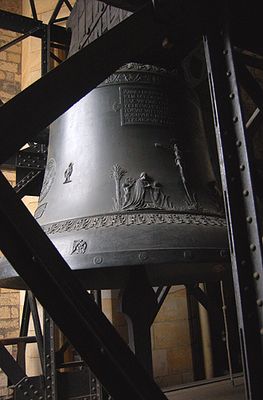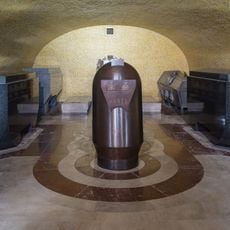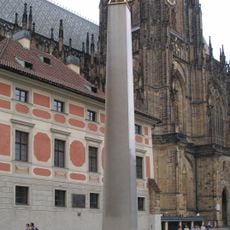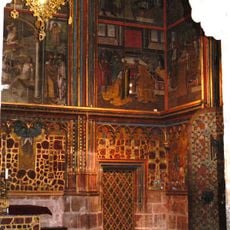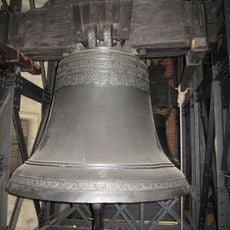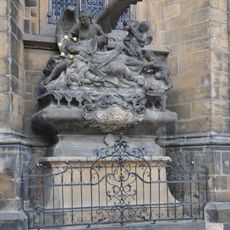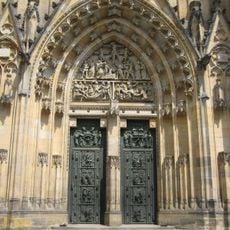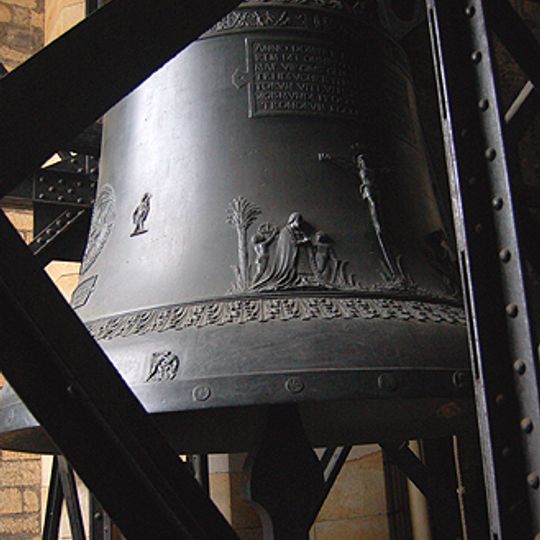
Sigismundglocke, Bronze church bell in St. Vitus Cathedral, Prague, Czech Republic.
The Sigismundglocke is a bronze bell cast in 1549 by Tomáš Jaroš of Brno, with a lower diameter of 256 cm, a height of 203 cm and an estimated weight of 16.5 tonnes. Its crown consists of six ears decorated with a bearded faun's face, and its cap and neck carry acanthus bands, a tenfold relief of the Massacre of the Innocents, and Latin inscriptions with reliefs of Ferdinand I and Anna of Jagiellon.
Tomáš Jaroš of Brno cast the bell in Prague in 1549, as its Latin inscription states, for King Ferdinand I and Queen Anna. Its main relief was commissioned by the king, and the bell-maker chose the rest of the decoration under approval of the royal council. The original clapper broke in 1592 during ringing for the funeral of Vilém of Rožmberk; later clappers cracked in 1670, 1734, 1797 and 2002, the last replaced that same year.
The bell is rung by hand, as are all the bells hanging in the same tower of Saint Vitus Cathedral. Its decoration includes reliefs of the Annunciation and the Holy Trinity taken from engravings by Albrecht Dürer, and the eastern side shows King Ferdinand I and Anna of Jagiellon kneeling at the cross.
The tower where the bell hangs is not open to the public, but the bell can sometimes be seen from specific viewpoints within the cathedral. Visiting during a major religious feast gives the best chance of hearing it ring.
The bell's heart, the clapper, has repeatedly cracked: it broke in 1592 during ringing for the funeral of Vilém of Rožmberk without injuring anyone, split again in 1670, 1734 and 1797, and the repaired heart burst on 15 June 2002 during evening ringing for the feast of Saint Vitus. A new heart from Petr Manoušek's workshop in Zbraslav was first rung on Saint Wenceslaus Day, 28 September 2002.
The community of curious travelers
AroundUs brings together thousands of curated places, local tips, and hidden gems, enriched daily by 92,157 contributors worldwide.