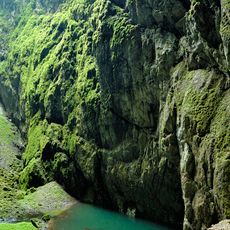
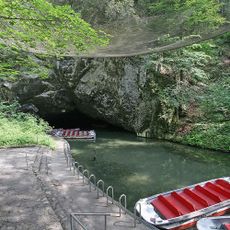
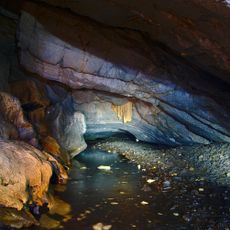
Kateřinská jeskyně, Limestone cave in Moravian Karst, Czech Republic
Kateřinská Cave is a limestone cave in the Moravian Karst whose Main Dome, reached through a Gothic portal, measures 97 m long, 44 m wide and 20 m high, the largest underground chamber open to the public in the Czech Republic. Beyond it lie the New Cave with the coloured 'Witch' stalagmite and the 'Bamboo Forest' of tall stick stalagmites and stalagnates, plus the Chaos Dome linked vertically to Dante's Hell above.
Kateřinská Cave opened to the public in 1910. In 1909 a team led by Professor Karel Absolon discovered the section now called the New Cave. Excavations yielded abundant bones of Pleistocene animals, mainly bears, and in 2019 charcoal drawings about 4,200 years BC were found on the walls, the oldest prehistoric paintings in the Czech Republic.
The cave's name comes from a local legend about a shepherdess named Kateřina who sheltered there from a storm and lost her way in the passages. Concerts are held in the Hlavní dóm, whose acoustics suit music and singing. A fragment of a clay tablet with cuneiform writing was found in the cave.
The cave maintains a constant cool temperature of about 7 degrees Celsius throughout the year, so visitors should bring warm clothing. Access is only possible by joining guided tours, which operate with different frequency during summer and winter periods.
In 2019, charcoal drawings about 4,200 years old were found on the cave walls, the oldest prehistoric drawings known in the Czech Republic. The cave also shelters 11 species of bats and greater horseshoe bats through the winter, which is why it closes in December, January and February.
The community of curious travelers
AroundUs brings together thousands of curated places, local tips, and hidden gems, enriched daily by 94,051 contributors worldwide.