Ball Game Hall, Civic building in Prague, Czech Republic
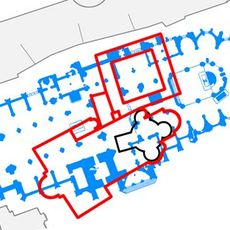
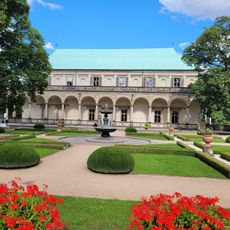
The Ball Game Hall (Míčovna) is a Renaissance building in the Royal Garden of Prague Castle, constructed in 1568–1569 by Bonifác Wolmut for Emperor Maximilian II. Its nearly 80-metre-long north wall features 11 stone half-columns with Ionic capitals and is covered with figurative and ornamental sgraffito, including allegories of virtues and the seven liberal arts.
Bonifác Wolmut built the hall in 1568–1569 for Emperor Maximilian II, on the edge of the Stag Moat, where poor foundations soon required massive buttresses. The vault collapsed in 1617; after a fire in 1757 two floors were inserted around 1848, when it was to serve as barracks. A shell hit and fire in 1945 left only the outer walls, and Pavel Janák's 1952 reconstruction restored the barrel vault and sgraffito.
The building's Czech name, Míčovna, comes from the word for ball, recalling its original purpose. Since opening to the public in 1989, it has hosted exhibitions, concerts and social events rather than community activities.
The hall sits in a central location with good public transportation access, including tram stops and metro stations nearby. The surrounding area has flat terrain and is easy to explore on foot.
The hall's playing area was twice the size recommended by Antonio Scaino's 1555 Italian treatise on tennis, and the interior was originally painted black so the ball stood out. In one arcade arch, the 1952 restoration added a gear wheel with the number five, a sickle and a hammer.
The community of curious travelers
AroundUs brings together thousands of curated places, local tips, and hidden gems, enriched daily by 92,158 contributors worldwide.