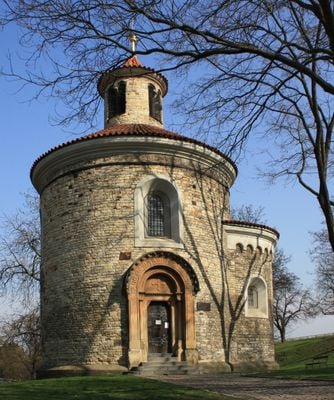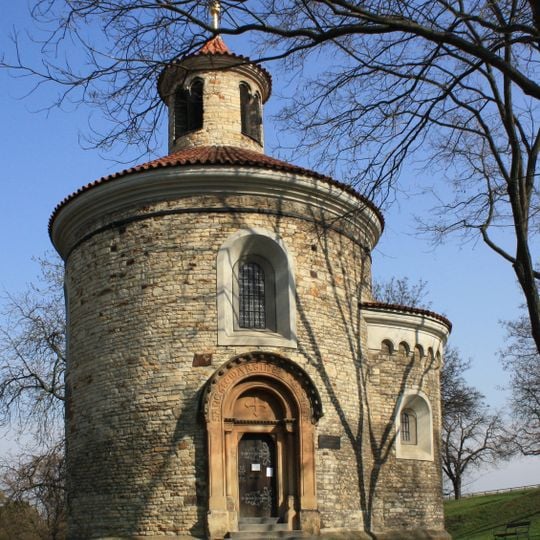
Rotunda of Saint Martin, Romanesque rotunda in Vyšehrad, Prague, Czech Republic
The Rotunda of Saint Martin is a cylindrical stone chapel with a conical roof, built of rough light-coloured blocks; its interior diameter is 6.5 m and the walls reach 95 cm thick. A lower apse projects 2.2 m on the east side, and a small lantern with four windows sits at the top.
Built at the end of the 11th century under Prince Vratislav II, the rotunda was probably founded by Martin, dean of the Vyšehrad chapter, and served as the parish church of the Vyšehrad suburb. Hussite raids in 1420 damaged its decoration, a fire struck it in 1528, and during the Thirty Years' War it was used as a gunpowder store. Deconsecrated under Joseph II and later a warehouse and workshop, it was saved from demolition in 1841 by Count Karel Chotek.
The rotunda is dedicated to Saint Martin, the Roman soldier who cut his cloak in half for a beggar; the apse wall above the altar carries a 19th-century painting of him, with a blessing Christ and angels on the vault. Masses are still held here regularly, and the Vyšehrad chapter owns the building.
Interior access is by arrangement with the Vyšehrad chapter, which owns the rotunda; it is not a freely open monument. Regular masses are held inside, so visits depend on agreeing a time with the chapter. The nave is only 6.5 m across and the walls up to 95 cm thick, so the space is small.
A Prussian cannonball from the 1757 siege remains embedded in the facade next to a window as a testament to wartime. This unexpected detail tells a story from a turbulent past.
The community of curious travelers
AroundUs brings together thousands of curated places, local tips, and hidden gems, enriched daily by 92,165 contributors worldwide.