Rotunda of Saint Wenceslaus, Romanesque religious site in Prague, Czech Republic
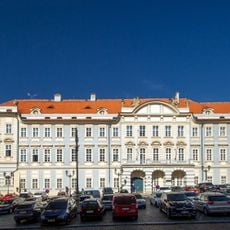
The Rotunda of Saint Wenceslaus survives as excavated masonry under the northwest corner of the former Jesuit Profess House on Malostranská náměstí: low foundations, an arched stone recess, and courses of flat red brick capped with light stone. Its most valued relic is a fragment of the original Romanesque floor, 74 terracotta tiles in three shapes laid in five rows.
The prince built this rotunda around 925 after receiving a sacred relic from a Saxon ruler. The building became a key landmark in early Christian development in Bohemia and was eventually supplemented by larger churches.
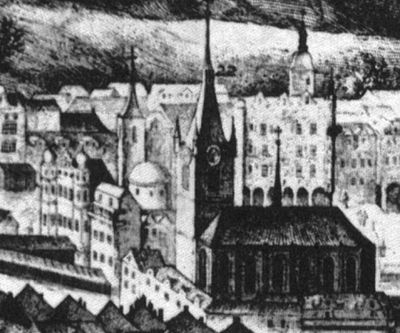
The rotunda's name comes from Saint Wenceslaus, whose funeral cart reportedly stopped here on 4 March 932 or 938 until unjustly imprisoned people nearby were freed. In the high Middle Ages it served as a burial chapel for the parish church of St Nicholas, and after 1628–29 it became the parish church of Malá Strana.
The rotunda lies under the northwest corner of the former Jesuit Profess House on Malostranské náměstí, not at Prague Castle. It is normally closed to the public; the corridor of the Faculty of Mathematics and Physics holds computer presentations, info panels with photographs and replicas of the floor tiles.
The most valuable find is a fragment of the original Romanesque floor: 74 tiles in three shapes laid in five rows, the oldest type of medieval terracotta flooring in Bohemia. A curved ring of flat, smoothed opuka stones from the 10th century was also uncovered, its purpose still unknown.
The community of curious travelers
AroundUs brings together thousands of curated places, local tips, and hidden gems, enriched daily by 92,372 contributors worldwide.