Thun Palace, Baroque palace in Malá Strana, Czech Republic.
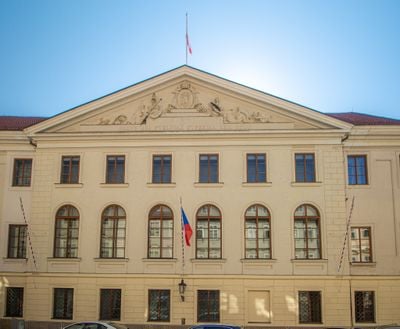
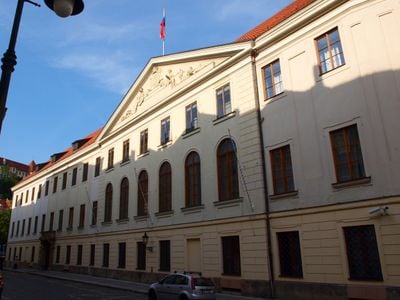
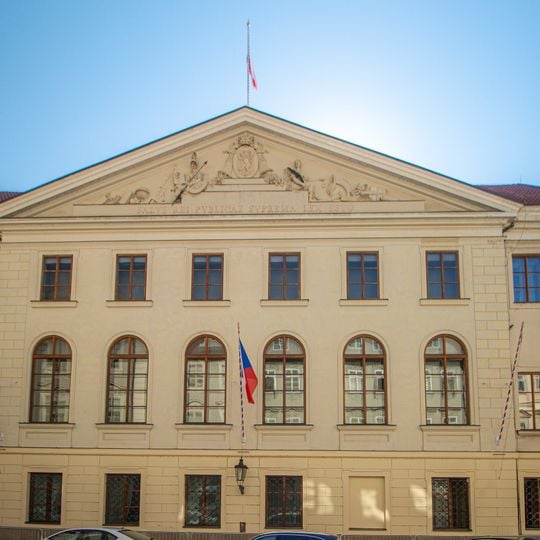
Thun Palace is a baroque residence in Malá Strana featuring a curved facade that runs roughly 90 meters along the street. The front displays the coat of arms of the Kingdom of Bohemia, making it a landmark that draws the eye in this historic neighborhood.
The original Roupov House was bought in 1650 by Countess Markéta Anna of Thun-Hohenstein, and the Thuns acquired two neighbouring buildings in 1662 and 1694. In 1801 Countess Anna Marie of Thun-Hohenstein sold the palace to the Bohemian Estates, after which a Neoclassical rebuilding adapted it for the provincial diet; it has served as a parliamentary chamber since 1861. On 14 November 1918 the Revolutionary National Assembly proclaimed Czechoslovak independence here and elected Tomáš Garrigue Masaryk president.
From 1779 the palace housed an Italian opera company led by Pasquale Bondini, who engaged the castrato Pietro Gherardi and staged at least 33 productions, mostly opera buffa, including works by Salieri, Paisiello, Cimarosa and Mozart. Emperor Joseph II is said to have attended. The theatre burned down in 1794.
The building now houses the Chamber of Deputies of the Parliament of the Czech Republic, so access is limited and available mainly during special events or organized tours. Visitors should check ahead to learn about open days and what arrangements are needed to view the interior.
The Latin motto in the pediment, SALUS REI PUBLICAE SUPREMA LEX ESTO, replaced an earlier inscription reading FRANCISCO II. AVSPICE REBVS PATRIAE AGVNDIS BOHEMIAE ORDINES MDCCCI, which dated from the 1801 classicist rebuilding for the Bohemian Estates. The change came after 1918, when the palace became a Czechoslovak institution.
The community of curious travelers
AroundUs brings together thousands of curated places, local tips, and hidden gems, enriched daily by 92,380 contributors worldwide.