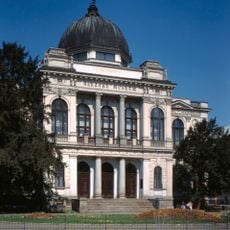
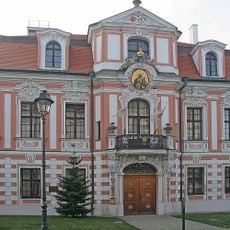
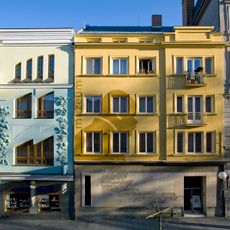
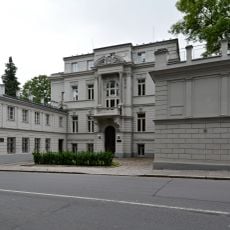
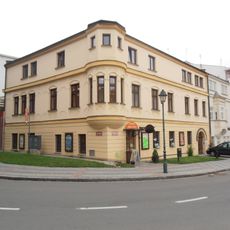
Městský dům kultury Petra Bezruče, House of Culture in Opava-Předměstí, Czech Republic.
The Městský dům kultury Petra Bezruče is a building in central Opava designed by Leopold Bauer and built in 1908–1910. Its interior is dominated by a massive marble double-wing staircase to the first floor, and the main hall has stained glass windows by Adolf Zdrazila showing women as symbols of Silesian crafts. Above the main entrance are four sculptures by Josef Obeth, who also made sixteen stone reliefs on the facade.
The building was constructed between 1908 and 1910 following Leopold Bauer's winning design and initially functioned as the Chamber of Commerce. Following its nationalization in 1949, it was transformed into a cultural center.
The building's name honours poet Petr Bezruč, and its ceremonial hall holds a Rieger Klos organ built in 1978, whose console layout and controls closely match the instrument in Opava's Co-Cathedral of the Assumption of the Virgin Mary. The hall still hosts weddings and citizenship ceremonies.
The library on the ground floor provides a natural starting point for exploring the building, while the organ hall and event salon upstairs are accessible by stairs or elevator. Visitors can wander through public areas independently or attend scheduled cultural programs.
Above the main entrance stand four sculptures by Silesian sculptor Josef Obeth, who also carved sixteen stone reliefs across the facade. The entrance doors themselves follow Leopold Bauer's design, with a figural motif by Viennese sculptor Gustav Gurschner. Bauer also designed the light fittings, ironwork and decorative grilles.
The community of curious travelers
AroundUs brings together thousands of curated places, local tips, and hidden gems, enriched daily by 92,813 contributors worldwide.