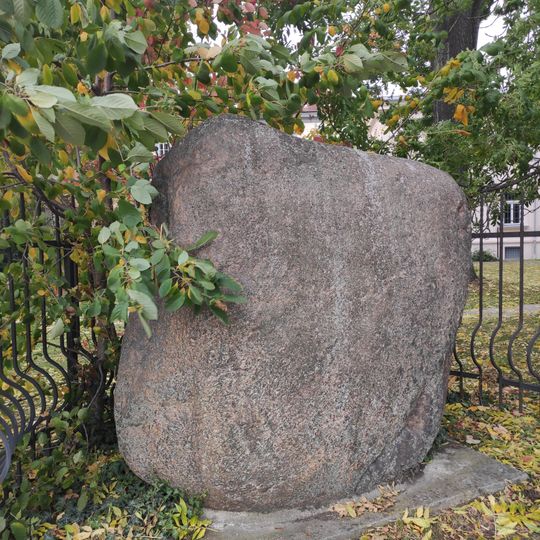
Erratic Boulder in Opava, Glacial boulder in Praskova, Czech Republic
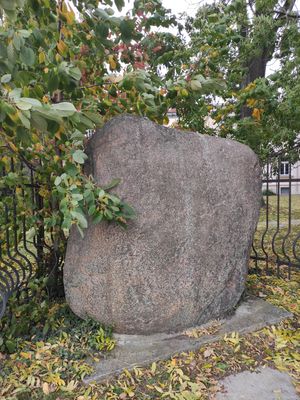
The Erratic Boulder in Opava is a roughly block-shaped granite boulder with rounded edges, measuring 2.1 × 1.8 × 1.1 m and weighing about 11,700 kg. It lies on Praskova Street in the Město district and is the largest erratic boulder found in the Opava district. Its coarse-grained deformed granite holds grey-red potassium feldspar grains up to 4 cm across and light grey to purplish quartz.
The boulder was found in May 1958 by Ladislav Zapletal in a sand pit at Palhanec, north of Opava. On 25 July 1958 it was moved to Praskova Street and set on a concrete base after a technically difficult transport. It had been carried from Småland in south-east Sweden by the continental ice sheet during the ice age.
The boulder was found in May 1958 by a local boy, Ladislav Zapletal, in a sand pit at Palhanec north of Opava, and on 25 July 1958 it was hauled into the city and set on a concrete base. Communist officials of the time worried that the stone's fame might overshadow the nearby statue of Klement Gottwald.
The boulder stands on a concrete base on Praskova Street in Opava-Město and can be visited freely all year round. It is the largest erratic boulder found in the Opava district, measuring 2.1 × 1.8 × 1.1 m and weighing about 11,700 kg. Look for the grey-red potassium feldspar grains up to 4 cm across in the coarse granite.
The boulder's origin is not vague: it comes from Småland in south-eastern Sweden, carried to Opava by the extinct continental ice sheet. Its coarse deformed granite holds grey-red potassium feldspar grains up to 4 cm across, alongside pale grey to purplish quartz.
The community of curious travelers
AroundUs brings together thousands of curated places, local tips, and hidden gems, enriched daily by 92,703 contributors worldwide.