Church of Saint Leonard, Church ruin in Karlovy Vary, Czech Republic
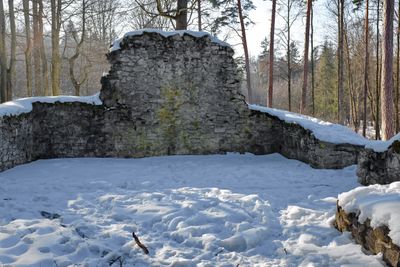
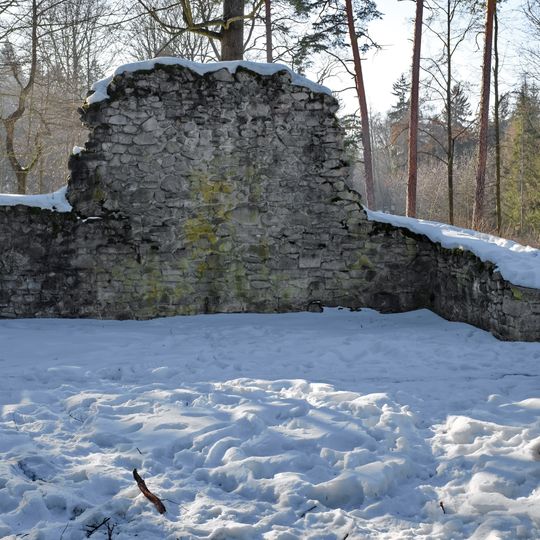
The Church of Saint Leonard is a ruined single-nave church on a hill above the vanished village of Obora near Karlovy Vary. Its rectangular nave measures 12.5 by 10 metres and adjoins a square presbytery of 8 by 8 metres; the rubble-stone walls, bound with mortar containing Karlovy Vary vřídlovec sinter, are 120 cm thick. Foundations of two side altars survive in the nave corners, and conical portals led north to the village and south to the cemetery.
The church is first documented in 1246, when King Wenceslaus I donated it to the Order of the Red Star Crusaders. It stood above the vanished village of Obora, first mentioned in 1325, and by the mid-14th century both had passed to the new town of Karlovy Vary. The parish was abolished at the end of the 15th century and transferred to Karlovy Vary, after which the church fell into ruin.
The church was given to the Order of the Knights of the Cross with the Red Star by King Wenceslaus I in 1246, and the parish was abolished at the end of the 15th century, when it was transferred to Karlovy Vary. Excavations from 1989 uncovered dozens of burials in four to five layers, including a young woman buried crouched with bound limbs, and about forty metal votive figurines of animals and people.
The ruins are accessible via marked trails within the protected landscape area surrounding Karlovy Vary. Wear sturdy footwear and come prepared for a forest walk, as the church sits deep in wooded terrain away from town centers.
The mortar binding the rubble walls contains vřídlovec, the Karlovy Vary thermal sinter, a detail noted by spa physician David Becher in 1722. The same mortar was later found at St Nicholas church below Krudum hill. Excavations in 1989 uncovered dozens of burials in four or five layers and about forty metal votive figurines of animals and people.
The community of curious travelers
AroundUs brings together thousands of curated places, local tips, and hidden gems, enriched daily by 94,023 contributors worldwide.