Krausova vila, Cultural monument in Moravská Ostrava, Czech Republic
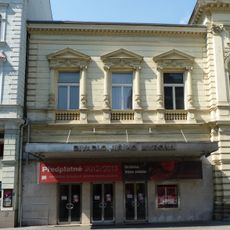
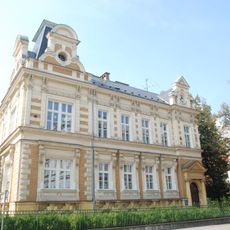
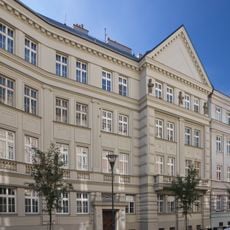
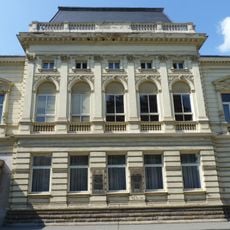
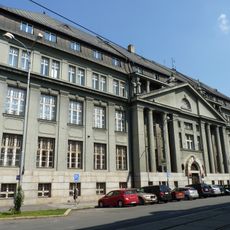
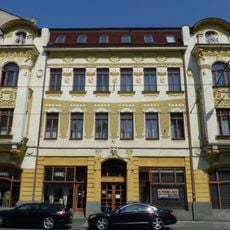
Krausova vila is a four-storey villa with one basement at Nádražní 10 in Moravská Ostrava. Its late Art Nouveau form with a mansard roof was extended in 1920 by Ernst Korner with a monumental portico of eight pairs of Doric columns, topped by Augustin Handzel's allegorical group of Family Happiness, Commerce, Abundance and Industry.
The first records of the building date to 1859. It was rebuilt in 1910–1911 for Dr. Karel Kraus, a lawyer and leading figure of Moravská Ostrava's German community, to plans by Hans Ulrich and Alois Schön. After Kraus died in 1919, Česká banka Union bought it and had Ernst Korner add a floor and a monumental portico. From 1945 to 1990 it housed the Museum of Revolutionary Struggles.
The attic figures by Ostrava sculptor Augustin Handzel are four allegories: Family Happiness, Commerce (the god Mercury), Abundance and Industry, flanked by paired vases. The left wing of the portico was demolished after World War II; its site now forms the small Nádražní piazzetta, while the right wing houses a newsstand.
The building sits in the center of Moravska Ostrava and is easily visible from the street. Visitors can view the exterior and architectural details, though interior access depends on current building management policies.
The villa's attic figures were restored in 2010 for the building's centenary: Jakub Gajda and Roman Winkler worked on the sculpture group and vases at a cost of over 900,000 CZK, a quarter paid by the city. The four allegories, from left, are Family Happiness, Commerce (Mercury), Abundance and Industry.
The community of curious travelers
AroundUs brings together thousands of curated places, local tips, and hidden gems, enriched daily by 92,776 contributors worldwide.