The Great God Pan, Bronze sculpture at Columbia University campus, US
The Great God Pan is a bronze sculpture on the campus of Columbia University in New York, showing a half-man, half-goat figure reclining on a granite base while playing reed pipes. The figure is modeled in a naturalistic style, with smooth surfaces and a relaxed, flowing pose.
Barnard conceived the sculpture in 1894 as a fountain for the courtyard of The Dakota, the Upper West Side apartment building. After patron Alfred Corning Clark died in 1896, his family offered Pan to New York for Central Park, but the Parks Commission rejected it. Edward Clark then funded the bronze casting, completed in a single piece by the Henry-Bonnard Bronze Company in August 1898, and the work was donated to Columbia, where it was installed in 1907.
Barnard gave Pan the ears and cloven hooves of a goat but left off the horns and tail, so the god reads as a muscular, bearded man resting on a rock. The bronze sits on a green granite base with three bronze lion heads, built by architect Charles McKim of McKim, Mead & White for use as a fountain.
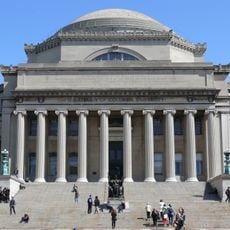
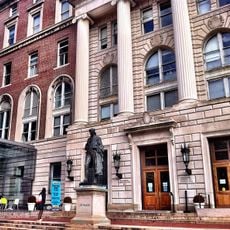
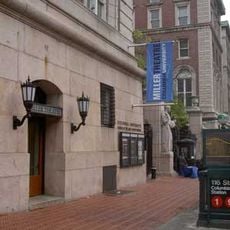
The sculpture stands outdoors on the main grounds of Columbia University in Morningside Heights, north of West 116th Street, between Lewisohn Hall and Low Memorial Library. The area is easy to walk through, and the work can be seen as part of a broader stroll across the campus.
The Henry-Bonnard Bronze Company cast the entire figure in a single pour, which was an unusual approach for a work of that size at the time. Keeping the metal consistent across such a large form required a high level of control during the casting process.
The community of curious travelers
AroundUs brings together thousands of curated places, local tips, and hidden gems, enriched daily by 92,722 contributors worldwide.