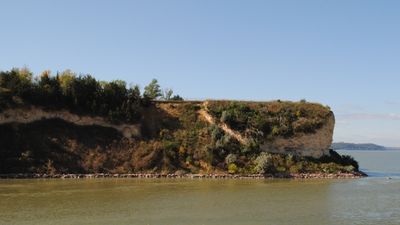
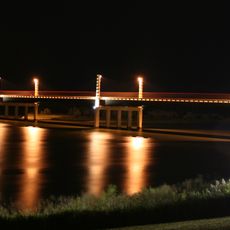
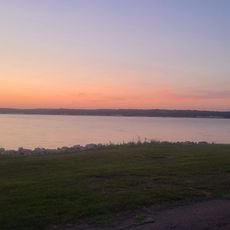
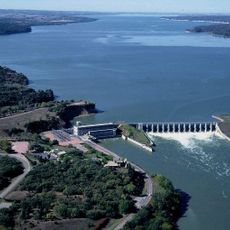
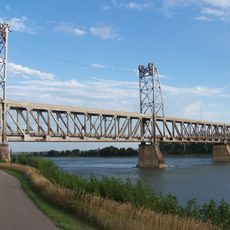
Calumet Bluff, Cliffside overlook in Cedar County, Nebraska, United States.
Calumet Bluff is a limestone cliff formation rising roughly 180 feet (55 meters) above Lewis and Clark Lake and the Missouri River. The rock face displays distinct layers of yellowish-red and brown clay that reveal the geological history of the region.
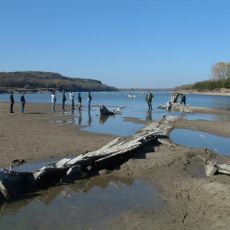
Members of the Lewis and Clark expedition camped below this cliff from August 28 to September 1, 1804, marking an important moment in their journey westward. During their stay, they held their first official council with Sioux tribes in this location.
The name Calumet was long read as a peace pipe, but the source notes this is a misinterpretation: at the time it named a Golden Eagle, a bird that nests on bluffs and whose feathers were probably carried on the peace pipe. Clark recorded the hill as "White Bear Clift" after one of those animals was killed in a hole in it.
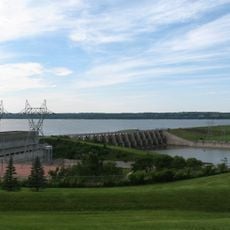
A trail roughly 1.5 kilometers long leads to several observation points where you can view the cliff and river from different angles. The site is managed by the U.S. Army Corps of Engineers and offers accessible routes for visitors of varying abilities.
The name Calumet was long taken to mean a peace pipe, but the term was actually a name for a Golden Eagle; eagles nest on bluffs like this one, and their feathers were probably carried on peace pipes. Clark recorded the hill as "White Bear Clift" after one of the animals was killed in a hole in it.
The community of curious travelers
AroundUs brings together thousands of curated places, local tips, and hidden gems, enriched daily by 93,933 contributors worldwide.