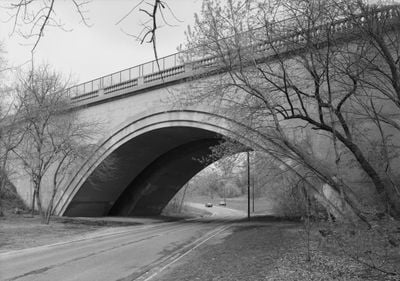
16th Street Bridge, Concrete bridge on 16th Street Northwest, Washington D.C.
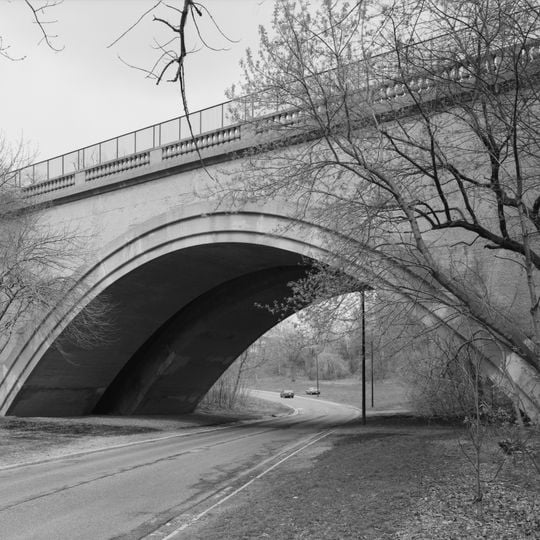
The 16th Street Bridge, also called the Piney Branch Bridge, carries 16th Street NW over Piney Branch and Piney Branch Parkway on a single parabolic concrete arch 125 feet long with a 45-foot rise. The pale gray concrete face has a darker arch ring, and a balustrade railing runs along the deck. The arch is not reinforced with steel; the abutments and substructure are reinforced concrete.
Congress authorized extending 16th Street NW in 1899, and work reached Piney Branch in 1903. The first span went up in 1905–1907 but was never opened to traffic; a second span followed in 1909–1910. Its designer, W.J. Douglas, called the parabolic arch the first in the United States and the longest in the world at the time. Renovations came in 1990 and from October 2014.
The bridge marks the meeting point of Sixteenth Street Heights, Crestwood, Columbia Heights and Mount Pleasant, where 16th Street NW crosses Piney Branch. Its deck carries a 45-foot roadway with 8-foot sidewalks on each side, and four ornamental cast iron lampposts stand along it. Two bronze reclining tigers on concrete pedestals flank the ends.
The deck is 65 feet wide: a 45-foot roadway with 8-foot sidewalks on each side, edged by granite curbs. The span crosses Piney Branch about 60 feet above the stream, so the sidewalks give a view down into the valley. Four cast iron lampposts stand on the bridge, and bronze reclining tigers flank each end on concrete pedestals.
The concrete contains crushed blue diorite, a natural stone that gives the surface a distinctive grainy texture visible up close. This unusual material choice makes the bridge stand out from other structures built during that era.
The community of curious travelers
AroundUs brings together thousands of curated places, local tips, and hidden gems, enriched daily by 94,021 contributors worldwide.