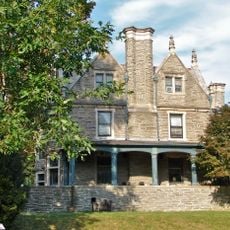
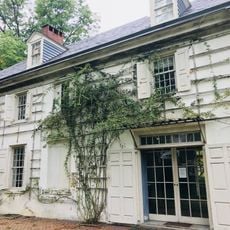
Phil-Ellena, Greek Revival mansion in Mount Airy, United States
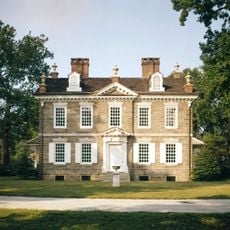
Phil-Ellena was a Greek Revival mansion distinguished by four fluted columns supporting a pedimented portico, with sculptures of Minerva and Eloquence carved by John Rush. The house sat on a 300-acre estate featuring two artificial lakes that supplied water to the property.
George Washington Carpenter bought over 500 acres in Germantown in 1836 and built Phil-Ellena on a 300-acre parcel in 1845. The house was demolished in 1892 as Mount Airy was developed; the clock tower followed in 1902. Carpenter's botanical collection went to the Philadelphia Horticulture Center and his museum specimens to the Academy of Natural Sciences.
Carpenter named the estate for his second wife, Ellen, and the surrounding streets keep the name: Germantown Avenue divides West from East Phil Ellena Street, while Pelham Road recalls Pelham, an alternative name for the house. Thomas Nuttall and John James Audubon visited the estate.
The estate stood near the intersection of Germantown Avenue and Pelham Road, in what is now West Mount Airy. Two segments of West Phil Ellena Street lie within its former boundaries, and Pelham Road runs through the former grounds. The house itself was demolished in 1892, so nothing of the mansion remains.
The 65-foot clock tower on the estate was demolished in 1902, a decade after the main house came down in 1892. Carpenter's botanical collection went to the Philadelphia Horticulture Center, and his museum specimens were transferred to the Academy of Natural Sciences of Philadelphia.
The community of curious travelers
AroundUs brings together thousands of curated places, local tips, and hidden gems, enriched daily by 92,640 contributors worldwide.