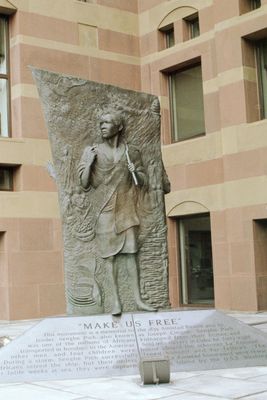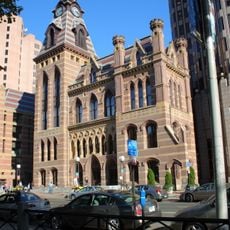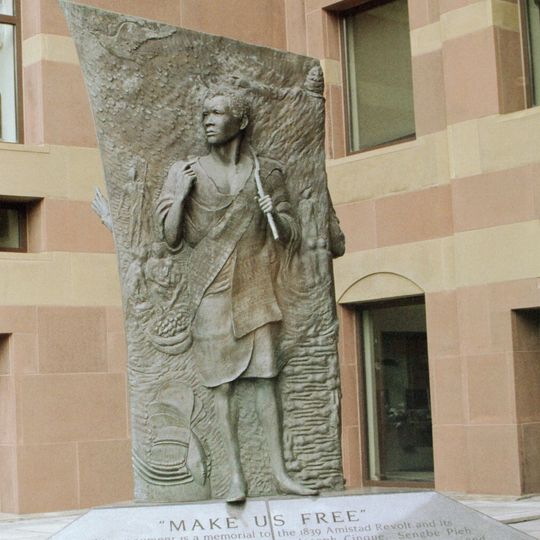
Amistad Memorial, Bronze monument near City Hall in New Haven, Connecticut, US.
The Amistad Memorial is a bronze sculpture on the public plaza next to City Hall in New Haven, Connecticut. It features three relief panels arranged around a central form, each depicting a different moment, with figures, water, and hands as the main visual elements.
In 1839, captives aboard a ship called the Amistad seized control and were eventually brought to trial in New Haven, where courts ruled in their favor. The memorial was dedicated more than a century later to mark that trial and keep the memory of those events in the place where they unfolded.
The memorial's three sides show Joseph Cinqué in African dress, in court, and after winning his freedom; a fourth face, turned upward, shows a face and hands in water and is visible only from City Hall's upper floors. Sculptor Ed Hamilton linked it to Foone, a captive who drowned in the Farmington Canal. The 1992 dedication drew about 300 people in pouring rain, which Hamilton saw as the tears of Africans who never made the journey home.
The memorial stands on open public grounds and can be visited at any time without charge. Walking around the full perimeter lets you see each panel clearly, and taking a few steps back gives a better sense of the overall shape.
One panel shows only hands rising from water and is nearly invisible from ground level. It becomes clearly visible from the upper floors of the adjacent City Hall building, making a look down from above worth the effort.
The community of curious travelers
AroundUs brings together thousands of curated places, local tips, and hidden gems, enriched daily by 92,708 contributors worldwide.