Mount Kinabalu, Protected mountain summit in Sabah, Malaysia.
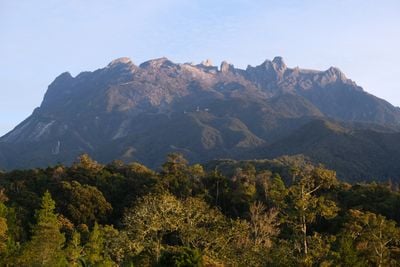
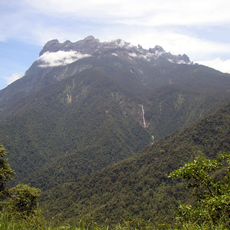
Mount Kinabalu is a granodiorite pluton that rises to 4,095 metres (13,435 ft) at Low's Peak, the highest summit in Malaysia and Maritime Southeast Asia, in Ranau district, Sabah. Its bare grey rock summit ridge has jagged peaks and notches above dark green mid-slopes, and its craggy form shows the work of Pleistocene glaciers.
In March 1851 Hugh Low set out from Labuan with a Dusun guide, Lemaing of Kampung Kiau, but failed to reach the summit, which was called inaccessible to any but winged animals. Low tried again with Spenser St. John in 1858; John Whitehead made the first ascent in 1888. Kinabalu National Park was created in 1964 and became a World Heritage Site in 2000.
The name derives from the Kadazandusun words aki, "ancestor", and nabalu, "mountain", giving "mountain of the ancestors", the resting place of Kadazandusun spirits. Dusun legend tells of a dragon guarding a hoard of pearls, and the mountain was long considered off-limits to climbers.
The two main routes require mandatory guides and advance registration at the park office in Ranau. Climbers usually stay overnight in mountain huts halfway up before completing the final section to the summit in the early morning.
The mountain slopes support over 5,000 plant species, including carnivorous pitcher plants that trap insects in cup-shaped leaves. On a rock wall near the mountain huts, dense carpets of mosses and lichens grow, soaking up mist and storing moisture.
The community of curious travelers
AroundUs brings together thousands of curated places, local tips, and hidden gems, enriched daily by 92,076 contributors worldwide.