Istana Seri Menanti, Royal timber palace in Kuala Pilah, Malaysia.
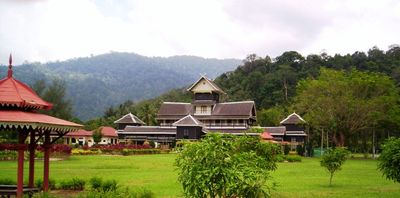
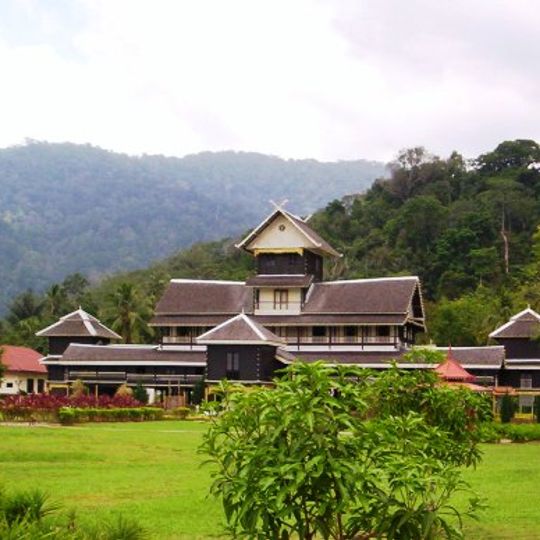
Istana Seri Menanti is a timber palace in Seri Menanti, Kuala Pilah District, raised on 99 pillars, four of them 67-foot chengal posts from Bukit Pergai, Jelebu. It rises five levels to about 67 feet, with tiered roofs whose gables curve upward like buffalo horns. The dark wooden facade has rows of small windows, lower wings on both sides and a central block topped by a small square cupola.
Istana Lama was built from 1902 to 1908 to replace Istana Pulih, which British soldiers burned while pursuing Yamtuan Antah during the Bukit Putus war. Two Malay craftsmen, Kahar and Taib, supplied the original design, redrawn by Mr. Woodford of the Public Works Department in Seremban and approved in November 1902. Tuanku Muhammad officiated the opening and lived there until 1931.
The roof takes the shape of buffalo horns, a Minangkabau symbol of peace, and the 99 pillars stand for the palace's 99 hulubalang, while the four central chengal posts from Bukit Pergai, Jelebu, represent the Orang Empat Istana. The palace hosted the mengadap ceremony every three years; in 1926 the High Commissioner Sir Lawrence Guillemard attended.
The palace stands in Seri Menanti, the royal capital of Negeri Sembilan, about 15 km from Kuala Pilah town. It became a Royal Museum on 14 July 1992 and was closed for repairs and upgrading works expected to finish in 2020, so confirm current opening before travelling. The building is listed as number 115 by the JKR.
The 99 pillars stand for the 99 palace officers (hulubalang), and the four central columns, each 67 feet tall, represent the four senior officials (Orang Empat Istana). The four main columns are chengal timber brought from Bukit Pergai in Jelebu.
The community of curious travelers
AroundUs brings together thousands of curated places, local tips, and hidden gems, enriched daily by 93,468 contributors worldwide.