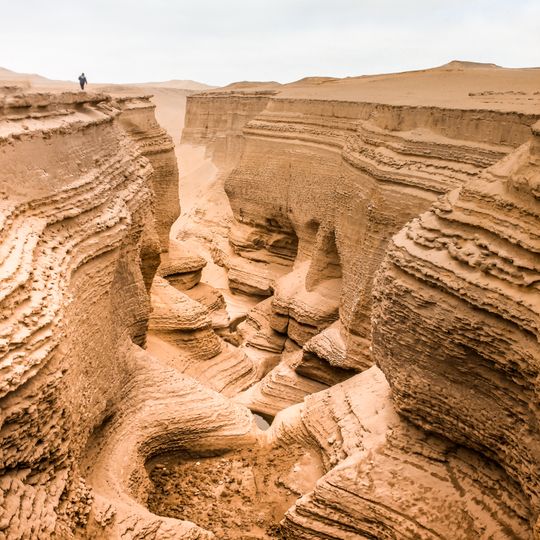
Cañon de los Perdidos, Natural canyon in Ocucaje desert, Peru.
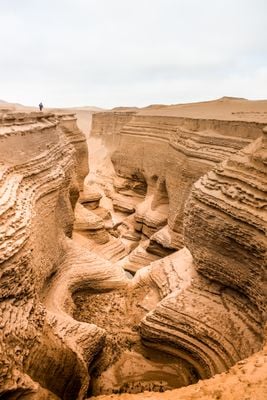
Cañón de los Perdidos is a canyon about 2 km long and 200 to 300 m deep, cut by the Seco River near where it met the Ica River in the Chilcatay sector. Its walls are pale tan and orange sand and rock, banded with horizontal strata and stepped into terraces. The floor narrows into a winding channel between rounded ledges and shelves, and small natural pools lie in hollows at the bottom.
On 11 June 2011, members of the Ocucaje Tourist and Cultural Promotion Association (APTYCO) organized a trip to the canyon, inviting Mayor Pablo Alvites, paleontologist Mario Urbina and journalist Maycol Herrera Benavides of Diario Correo Ica. Two vehicles set out; one group reached the canyon while the other got lost in the desert. Herrera titled his report "Cañón de los Perdidos", published on 12 June 2011, and the name stuck.
The name comes from the 11 June 2011 outing of the Asociación de Promoción Turística y Cultural de Ocucaje: one of two vehicles got lost in the desert, and journalist Maycol Herrera Benavides titled his Correo Ica report "Cañón de los Perdidos". Vultures (gallinazos) circle the rim and nest in the canyon. Near the entrance stand the "Cabeza de tortuga" and small fossilized shells.
The canyon lies 83 km from Ica via the Panamericana Sur; turn right at km 339 toward Callango and follow the left-bank track to Boca del Río, about two hours by simple-traction vehicle. Entry is free. No signs mark the descent points, and the route to the four levels and interior pools takes two to three hours.
The canyon has four levels or drops, and the walk through it, its surroundings and interior takes about two to three hours. At the entrance, called the Boca del Cañón, look for the Turtle Head and small fossilized shells. The route from Callango passes hills named Los Trenes, El Poseidón, El Delfín, Las Tetas and Serpiente Enroscada.
The community of curious travelers
AroundUs brings together thousands of curated places, local tips, and hidden gems, enriched daily by 92,605 contributors worldwide.