Saint Xavier of Nazca church, Jesuit church in El Ingenio District, Peru
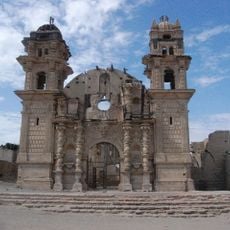
Saint Xavier of Nazca church is an abandoned rural chapel in San Javier, El Ingenio District, built in the 18th-century Peruvian Baroque style with native and Hispanic elements. Its east-facing front has two hexagonal towers, one holding a bronze bell dated 1746, an arched doorway flanked by paired columns, a shell-shaped niche and a medallion with the Jesuit emblem. Thick walls and a brick vault enclose a nave over thirty metres long; the 1942 earthquake brought down part of the vault.
The church was established during the period when Jesuits managed extensive vineyards and estates in the Ingenio Valley before their expulsion in 1767. This expulsion marked the end of their economic and religious influence in the region.
The name comes from the Hacienda San Javier, as the estate donated by Francisco Cabezas was renamed; the church kept it. The ornamentation shows native and Hispanic work together: 25 masks of hostile, round-faced warriors cover the frontis, and some motifs recall Jesuit missions as far away as India. In the sacristy dome, paintings of the four evangelists are still discernible.
The church stands abandoned and its structure has suffered severe damage, with part of the brick vault collapsed after the 1942 earthquake. Cracks in the vault and in the choir and presbytery walls make the interior unsafe, so it is viewed from outside rather than entered. The crypt below the altar, holding 52 tombs, is reached by a stairway.
In the vaulted crypt beneath the altar lie 52 tombs, reserved in the 18th century for local notables; the Franco-Argentine corsair Hipólito Bouchard was buried here after the Peruvian state granted him the hacienda following the Jesuits' expulsion. The crypt has a crematorium at its centre and a window that lights and ventilates it.
The community of curious travelers
AroundUs brings together thousands of curated places, local tips, and hidden gems, enriched daily by 93,501 contributors worldwide.