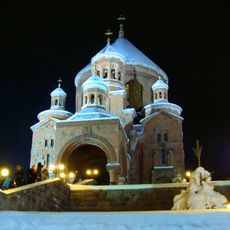
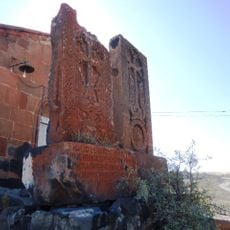
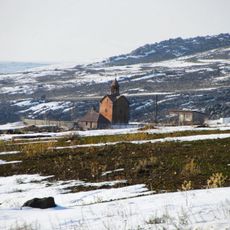
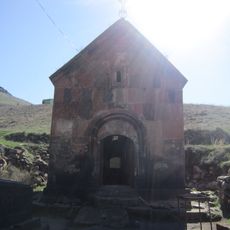
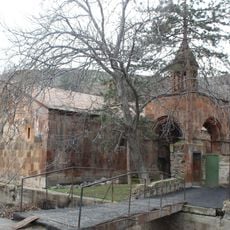
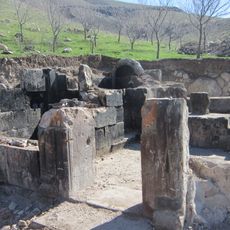
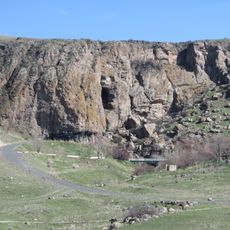
Aramus Tsiranavor church, Armenian religious monument in Aramus, Armenia.
Aramus Tsiranavor church is a centrally domed basilica in the village of Aramus, Kotayk Province, built on a rectangular plan slightly elongated on the east-west axis. Its corner rooms are barrel-vaulted, and the south-east one served as a prayer room or chrismarium. The dome square is stretched north-south, its sides differing by 60 cm, and the apse is 2.5 times taller than its opening.
Aramus Tsiranavor church was built in the 790s, according to the dating given in the sources. Historians Kirakos Gandzaketsi and Samvel Anetsi attributed its construction to the local catholicos David (728–741), but scholars now hold that David repaired a church damaged during the Arab invasions rather than built it. A. B. Yeremyan argued for an earlier date, the mid-6th century, when the anti-catholicos of Dvin Hovhan Bagaratsi may have resided here before the completion of Avan's catholicosal church.
The church is a centrally domed building, and its name Tsiranavor ("apricot-coloured") refers to the tuff stone of its walls. Historians Kirakos Gandzaketsi and Samvel Anetsi credited its construction to the local catholicos David (728–741), though scholars now hold that David repaired a church damaged during the Arab invasions rather than built it. The 6th-century date rests on the 145 cm fore-apses between the dome square and the east and west apses.
The church stands inside Aramus village in Kotayk Province, on the road that climbs toward the village centre. Only the first course of walling above floor level survives along the whole building, while in the north-east part three concrete masses six to seven metres high still hold facing stones, mostly on the inner side. Look for the carved window lintel and the toothed arch above the north-east side-chapel window on the outside of the east wall.
Only the first course of the walls survives above floor level across the whole building. In the north-east part, three concrete wall masses six to seven metres high still stand, with facing stones, mostly on the inner side, clinging in place; outside, the carved lintel of a round-topped window and a toothed arch with a plain side face remain.
The community of curious travelers
AroundUs brings together thousands of curated places, local tips, and hidden gems, enriched daily by 92,894 contributors worldwide.