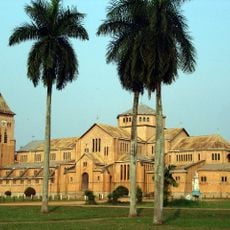
Cathedral of the Holy Saviour of Congo, Catholic cathedral ruins in M'banza-Kongo, Angola.
The Cathedral of the Holy Saviour of Congo, known locally as Kulumbimbi, stands in ruins in M'banza-Kongo. Its rectangular plan and walls of ferruginous stone are what remain of the first Christian church in sub-Saharan Africa. The thatched roof has disappeared and the structure was rebuilt several times during the 20th century. It lies beside the cemetery of the kings of Kongo.
Construction began between 6 May and 6 July 1491 under King João I of Kongo, and the church was later repaired and enlarged by 1534 under Afonso I. In 1570 troops of the East Jagas briefly took the city and burned the church, which was rebuilt. It was elevated to cathedral status in 1596 under Álvaro II, and after the Battle of Mbwila in 1665 the city was sacked repeatedly, the first time in 1668, before Pedro III's troops destroyed it in 1678 and left it in ruins.
The name refers to Christ and reflects the religious devotion that came with Catholicism arriving in the Kingdom of Kongo. Today visitors can walk through the ruins and imagine how royalty and their courts once gathered here for prayer and important ceremonies.
The ruins stand in the centre of M'banza-Kongo, beside the cemetery of the kings of Kongo, so they are easy to reach on foot from the town centre. Only the rectangular laterite-stone shell remains, with no roof, so the ground is uneven and exposed to sun and rain; wear sturdy shoes and bring water.
The ruins stand beside the cemetery of the kings of Kongo, and oral tradition among Kongo religious elders credits the Bacongo ancestors, not the Portuguese, with building Culumbimbi. For them the site recalls the era before colonisation changed traditional Kongo ways.
The community of curious travelers
AroundUs brings together thousands of curated places, local tips, and hidden gems, enriched daily by 92,623 contributors worldwide.