Yellala Falls, Waterfall system on Congo River in Kongo Central, Democratic Republic of the Congo
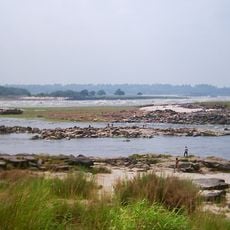
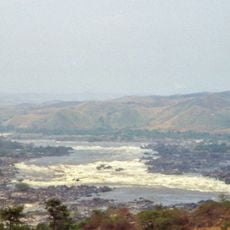
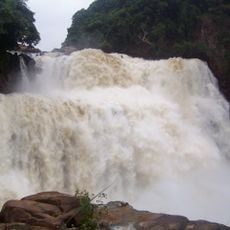
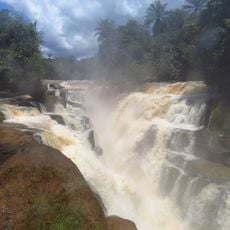
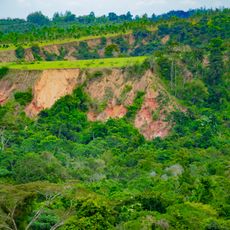
Yellala is a waterfall system on the Congo River that stretches for several kilometers through narrow gorges and rocky terrain. The water drops in distinct stages across the landscape, creating a dramatic cascade of flowing water and turbulent rapids.
Portuguese explorer Diogo Cão discovered this location in 1485 and left a stone marker to record his expedition on behalf of King John II. The site became known as a significant point marking early European exploration of the Congo region.
Tuckey recorded in 1816 that people living above the falls believed the site was the home of an evil spirit, and that anyone who saw the falls would never see them again. He also noted that above the falls fowls, eggs, manioc and fruit belonged to women, and men did not dispose of them without discussing it with their wives; beads were given as presents by the men.
The falls lie on the Congo River just upstream of Matadi, at the end of the 88 km lower stretch of the lower Congo that begins with the Inga rapids. The river is navigable below the falls to the ocean, but the rapids themselves are not passable by boat, so the site is reached on foot from the Matadi side. Tuckey, visiting in the dry season in 1816, found the falls diminished; water levels shape what you see.
The rapids and falls have largely isolated the Congo Basin's aquatic fauna for about five million years. The cichlid genera Steatocranus, Nanochromis, Lamprologus and Teleogramma occur only in the Congo basin, and all four Teleogramma species live only in the lower Congo rapids. Genetically distinct populations of the same fish have been found on opposite banks of the river.
The community of curious travelers
AroundUs brings together thousands of curated places, local tips, and hidden gems, enriched daily by 93,181 contributors worldwide.