La Campana National Park, National park in Olmué, Chile
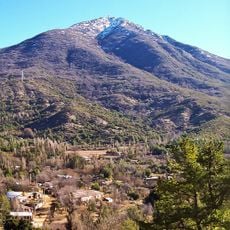
La Campana National Park covers about 80 square kilometres of the Cordillera de la Costa in Chile's Valparaíso Region, split into the Granizo, Palmas de Ocoa and Cajón Grande sectors, each occupying one of the three main basins. The Ocoa basin holds groves of Chilean wine palm (Jubaea chilensis), while Cerro La Campana, which resembles a bell when seen from the Aconcagua valley, rises in the smallest basin, Granizo.
Charles Darwin explored the terrain in 1834 during the HMS Beagle expedition, recording observations about flora and fauna. The area was later designated as protected land in the 20th century and recognized by UNESCO as a Biosphere Reserve.
The park takes its name from Cerro La Campana, whose bell shape is seen from the Aconcagua valley. The summit was climbed by Charles Darwin on 17 August 1834, during the second voyage of HMS Beagle. Trails today pass old mining remains, worked from pre-Columbian times into the 20th century.
The park has three entrances: Granizo and Cajón Grande, reached from the town of Granizo in Olmué, and Ocoa, reached from the town of the same name in Hijuelas. Information panels at each entrance map the trails with duration, difficulty and distance, and the same maps are free to download. Distances are one-way unless a route is a circuit, so double them to return in daylight. The Andinista Trail to the summit takes about 4 to 5 hours.
The reserve protects one of the last forests of Jubaea chilensis, the Chilean Wine Palm, which can reach heights up to 25 meters (82 feet). This slow-growing palm takes decades to reach full size, and many specimens here are several centuries old.
The community of curious travelers
AroundUs brings together thousands of curated places, local tips, and hidden gems, enriched daily by 93,842 contributors worldwide.