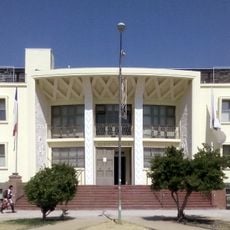
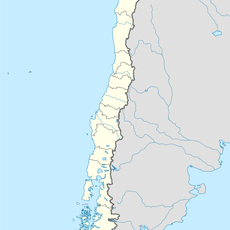
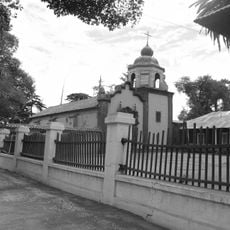
Cerro El Roble Observatory, Astronomical observatory in central Chile.
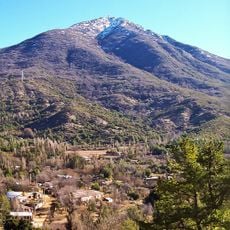
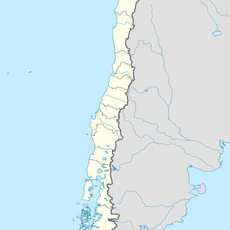
Cerro El Roble Observatory is an astronomical station on the northwestern face of the Coastal Range in central Chile, run by the University of Chile as part of the National Astronomical Observatory network. Its main instrument is the AZT-16, a Maksutov two-meniscus astrograph with a 700 mm aperture and 2076 mm focal length, built in 1964 at LOMO under designer Dmitry Maksutov.
The station arose from a 1965 agreement between the University of Chile and the Soviet Academy of Sciences, and the main Maksutov instrument was installed in 1967. Soviet astronomers left on 10 September 1973 after the military coup, handing the facility to the University of Chile. It was used until 1990, and from 2013 Russian scientists have sought to reactivate it.
The station's name comes from the hill it occupies, Cerro El Roble, and its main use today is teaching under the University of Chile. Soviet and Chilean astronomers worked side by side here; Carlos Torres, leading the Chilean team, discovered 37 asteroids between 1968 and 1982. The 700 mm Maksutov astrograph was built in 1964 at LOMO under optician Dmitri Maksutov's direction.
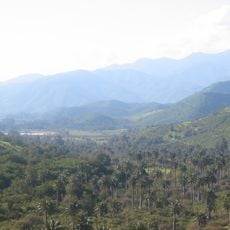
The station stands on the northwestern face of the Coastal Range, reached by a mountain road up Cerro El Roble; the site has no regular public visiting programme, so access depends on the University of Chile, which runs it for teaching. Check conditions before setting out, since the road and weather change with the season.
The station's Maksutov astrograph AZT-16, with a 700 mm aperture and a 5x5 degree field, was built in 1964 at LOMO under the direction of Dmitry Maksutov, its optical designer. From 1968 to 1987 the station published 4,753 astrometric measurements and helped find about 40 asteroids and 4 supernovae.
The community of curious travelers
AroundUs brings together thousands of curated places, local tips, and hidden gems, enriched daily by 94,005 contributors worldwide.