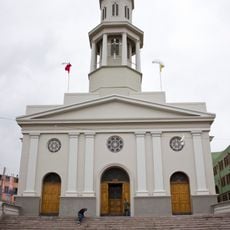
Cerro Cordillera, Historical hill in Valparaíso, Chile
Cerro Cordillera is one of Valparaíso's 42 hills, rising above Barrio Puerto from Calle Serrano. Its lower slopes hold the site of the San José fort, inaugurated in 1692; the building standing there today was the house of Scot Juan Mouat, who installed Chile's first astronomical observatory in 1843. The hill is crossed by staircases and the 1886 Cordillera elevator.
Cerro Cordillera was one of the first hills of Valparaíso to be settled, and the colonial authorities lived there. The San José fort was raised between 1682 and 1692 as the governor's residence, alongside the gobernación, the jail, the customs house and the barracks. In 1840 the fort's land was divided into lots and sold at public auction; the building standing today belonged to the Scottish immigrant Juan Mouat, who installed Chile's first astronomical observatory there in 1843. It was declared a National Historic Monument in 1963, under the mistaken name Castillo San José.
The architecture across the hill reflects European influences from the 19th century, stemming from when international merchants arrived during the city's commercial peak. These buildings continue to define the neighborhoods today and show how much the area was shaped by outside cultures.
The hill can be reached by two main routes: a historic elevator from 1886 or the Cienfuegos Staircase leading to Plaza Eleuterio Ramírez. Those who prefer a longer walk can take time to explore the streets and enjoy views over the city and harbor.
The lower section forms part of the UNESCO World Heritage site and houses one of the oldest elevator systems in South America. This mechanical landmark has changed little since its opening and reflects late 19th-century industrial innovation.
The community of curious travelers
AroundUs brings together thousands of curated places, local tips, and hidden gems, enriched daily by 94,050 contributors worldwide.