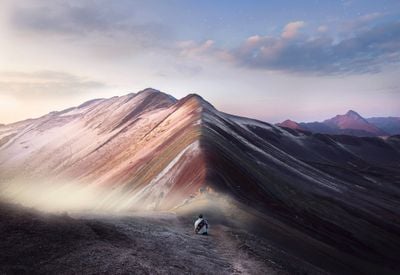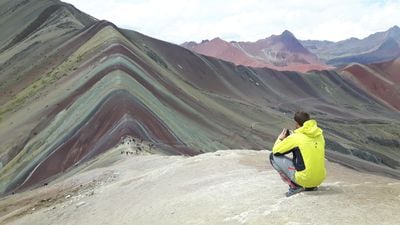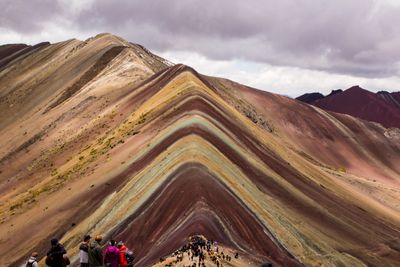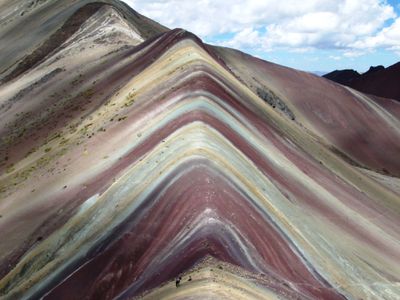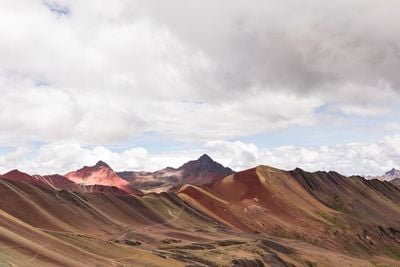
Vinicunca, Mountain ridge in Cusco region, Peru
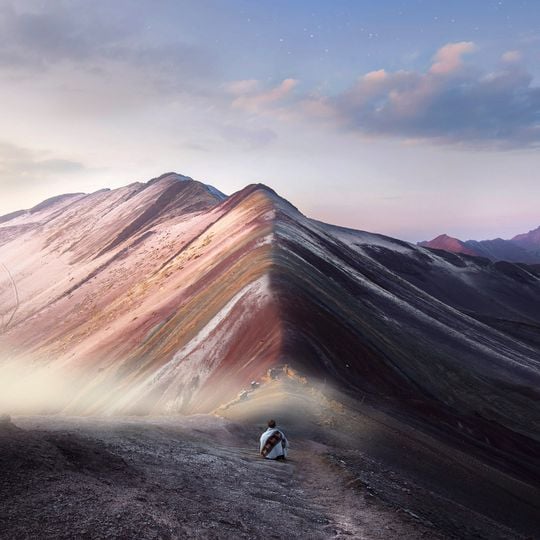
Mineral layers in shades of red, yellow, purple, and green stretch across the slopes of this Andean peak at 17,100 ft (5,200 m) elevation, forming parallel bands. The geological formations appear most clearly on the eroded flanks, where different sedimentary strata have been exposed through natural processes and create a distinctive striped pattern.
The rock layers formed approximately 24 million years ago during prolonged geological processes that deposited different minerals in succession. Ice sheets covered the area during glacial periods, preserving the sedimentary formations that were exposed only in recent times through glacier retreat and erosion. The site gained international attention after 2015.
Andean communities from the Pitumarca region maintain centuries-old connections to this mountain, which holds spiritual significance as a sacred place. Local residents now organize guided treks and provide accommodations, drawing on their traditional knowledge of the high-altitude environment while benefiting from the growing tourism sector that has developed around the site.
Access requires a several-hour drive from Cusco followed by a hike at elevations exceeding 16,400 ft (5,000 m), making proper acclimatization necessary. Most visitors depart before dawn and need warm clothing plus sun protection. Conditions between May and September offer drier weather with clearer visibility. Entrance tickets are sold at the trailhead, where basic food stands operate.
The color palette results from specific mineral compositions: iron oxides produce red and yellow tones, copper sulfates create green hues, while magnesium carbonates form whitish bands. Sulfur compounds contribute to yellowish areas. Color intensity varies with moisture and light conditions, with early morning sunlight enhancing contrasts most dramatically.
Location: Cusco Department
Elevation above the sea: 5,036 m
Part of: Jatunrritioc
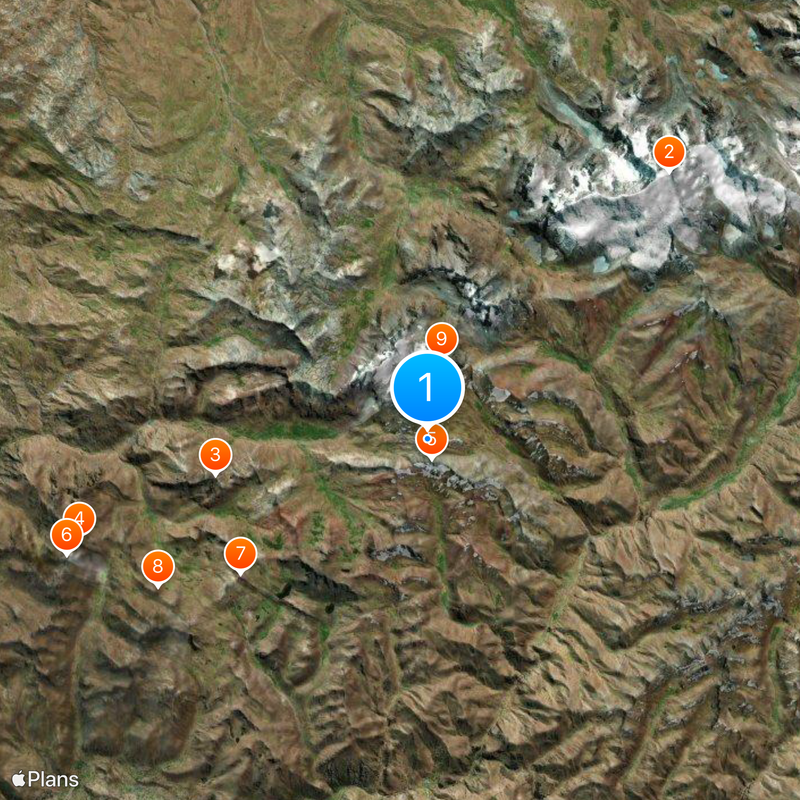
GPS coordinates: -13.86785,-71.30298
Latest update: December 1, 2025 09:16
This collection presents extraordinary natural phenomena and geological formations across all continents, from salt flats and volcanic crater fields to underground cave systems and landscapes shaped by mineral deposits. The featured sites display rare geological processes: moving stones leave mysterious tracks across California desert playas, methane gas feeds flames in a Turkmenistan crater for decades, and thermal springs create white travertine terraces in the Turkish countryside. Coral reefs form circular structures off the coast of Belize, while chemical reactions turn lakes pink in Australia and rivers brilliant colors in Colombia. The geological features include hexagonal basalt columns along the Northern Irish coast, conical limestone hills on Philippine islands, and mushroom shaped sandstone formations in Utah. Caves in New Zealand house thousands of bioluminescent larvae, while one of the world's largest caverns lies beneath Vietnamese mountains. Locations range from a geyser studded desert basin in Nevada to red algae carpets along Chinese shores to isolated islands off the Yemeni coast with endemic flora. This collection encompasses both ancient archaeological puzzles like stone jars in Laos and ground drawings in Peru, as well as natural optical illusions such as apparent underwater cascades off Mauritius.
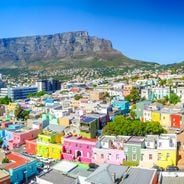
Earth displays its color range at numerous sites, from geological formations to human-built environments. The selection includes locations on six continents, where natural processes or cultural traditions have resulted in prominent visual displays. The Danxia mountains in China's Gansu province show layered sedimentary rock formations in reds, oranges and yellows, while Arizona's Painted Desert derives its colors from iron oxides and other minerals. Yellowstone's Grand Prismatic Spring owes its concentric bands of color to heat-loving bacteria that thrive in different temperature zones of the water. The Great Blue Hole off the coast of Belize reaches a depth of 407 feet (124 meters), providing a deep blue contrast to the surrounding turquoise shallows. Various communities have marked their built environment with distinctive color palettes. Chefchaouen in Morocco's Rif Mountains displays blue walls throughout its medina. Jodhpur in Rajasthan uses blue paint that originally marked Brahmin residences. Cape Town's Bo-Kaap presents houses in yellows, pinks, greens and blues, while Buenos Aires' La Boca neighborhood has corrugated metal facades in bright colors. Copenhagen's Nyhavn shows 17th and 18th century townhouses along the canal in reds, oranges, yellows and other hues. Scarborough's beach huts on the English coast offer a smaller scale of residential color. Water features contribute to the variety. China's Jiuzhaigou lakes display blues and greens due to calcium carbonate and algae. Tanzania's Lake Natron turns red to pink because of microorganisms living in its alkaline water. Pena Palace on a hilltop near Sintra, Portugal, combines yellow and red facades. Copacabana on Bolivia's Lake Titicaca offers whitewashed buildings with colorful accents. Hitsujiyama Park in Chichibu presents fields of phlox in pinks, whites and purples, while Kitakyushu's Kawachi Fuji Gardens feature wisteria tunnels. Even Longyearbyen on Svalbard displays colored wooden houses against Arctic landscapes.
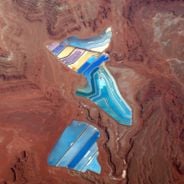
Satellite imagery has transformed how we view remote locations on Earth, offering perspectives on places that are often invisible or difficult to reach from ground level. This collection presents natural formations, artificial structures and historical sites from an aerial vantage point. From geological features like the circular Richat Structure in Mauritania's desert to ancient geoglyphs and modern engineering achievements, these images provide a distinct view of our planet's diversity. Locations documented include the geometric Nazca Lines in Peru, the pyramid structure of El Castillo in Mexico's Yucatán Peninsula and the Badlands Guardian in Alberta, a natural rock formation that resembles a head wearing headphones when seen from above. The collection also features Palm Jumeirah in Dubai, an artificial archipelago shaped like a palm tree, the vivid blue potash evaporation ponds in Utah, the pink waters of Lake Hillier in Western Australia and the volcanic island of Surtsey off Iceland. Additional examples include the Atacama Giant in Chile, a prehistoric geoglyph, the heart shaped Galesnjak island off Croatia's coast and the ship graveyard of the former Aral Sea in Uzbekistan, which documents the ecological consequences of human intervention.
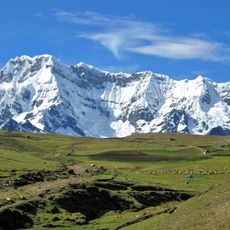
Ausangate
11.8 km
Queshuachaca
60.4 km
Tipón
61.6 km
Waqrapukara
45.4 km
Quelccaya Ice Cap
52.8 km
Quimsachata
33.4 km
Pachatusan
65.7 km
Rumicolca
51.6 km
Ninamarka
63.2 km
Qullpa Ananta
21.6 km
Jolljepunco
40.2 km
Chumpe
28.6 km
Cinajara
38.5 km
Tauja
58.5 km
Silkinchani
69.7 km
Yana Khuchilla
72.7 km
Unollocsina
50 km
Yurac Huayruro
57.9 km
Huaypun
61 km
Jatun Quenamari
54.3 km
Millo (Cusco)
47.5 km
Pata Anjasi
59 km
Tarucani
59.4 km
Cuncunani
56.9 km
Cuncapata
28.7 km
Temple of Wiracocha
34.9 km
Jachatira
58.2 km
Cunorana
54.3 kmReviews
Visited this place? Tap the stars to rate it and share your experience / photos with the community! Try now! You can cancel it anytime.
Discover hidden gems everywhere you go!
From secret cafés to breathtaking viewpoints, skip the crowded tourist spots and find places that match your style. Our app makes it easy with voice search, smart filtering, route optimization, and insider tips from travelers worldwide. Download now for the complete mobile experience.
A unique approach to discovering new places❞
— Le Figaro
All the places worth exploring❞
— France Info
A tailor-made excursion in just a few clicks❞
— 20 Minutes