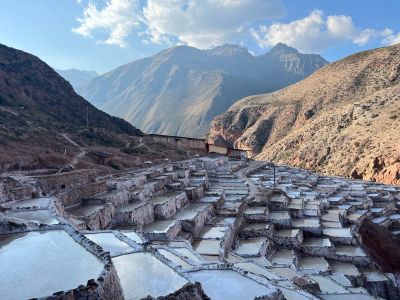
Maras solar salterns, Terraced salt evaporation ponds in the Sacred Valley, Cusco region, Peru.
The Maras solar salterns are a staggered grid of shallow rectangular wells on the slope of Qaqawiñay, built with retaining walls of irregular stone and clay. Each well measures about five square meters and thirty centimeters deep, fed by a saline spring that runs through a main channel and branches into smaller channels. Sources give roughly 4,500 to 5,000 wells.
Salt was worked at Maras from the Early Horizon onward; Chanapata ceramics found in the Pakallamoqo sector date to the Early Intermediate Period, and Killke (1000 AD) and Inca sherds also appear. In the 16th and 17th centuries the mines stayed with Inca descendants such as Don Felipe Topa Yupangui and Don Alonso Titu Atauchi; a Royal Decree of 1 November 1591 recorded their distribution among families and communities.
Around 400 families own the wells, held within families and passed down through generations; a pond can only be sold to another resident of Maras or Pichingoto. Owners do the extraction and upkeep, while the communal company Marasal handles storage, grading and sales, dividing profits by the number of wells each family holds.
The site is open daily from 6:00 AM to 6:00 PM and is located about 31 miles (50 kilometers) northwest of Cusco, accessible in one hour by road, with the dry season from May to September offering the best visiting conditions.
The brine comes from a saline spring at the top of the slope, which feeds a main channel that branches into smaller channels supplying each well. Each well yields about 200 kg of salt per month, and ponds can only be sold to other residents of Maras or Pichingoto.
The community of curious travelers
AroundUs brings together thousands of curated places, local tips, and hidden gems, enriched daily by 92,653 contributors worldwide.