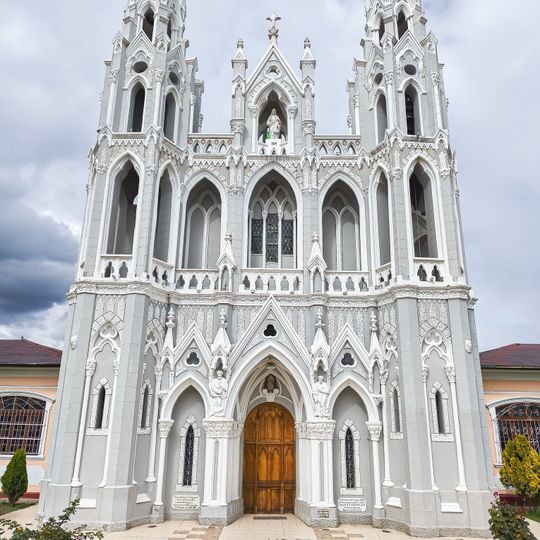
Capilla Cristo Pobre, Chapel in Junín region, Peru.
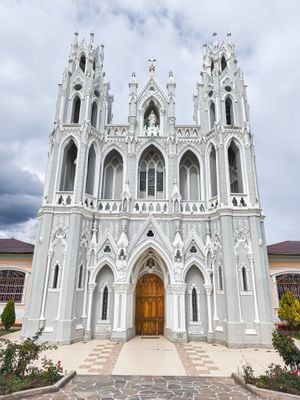
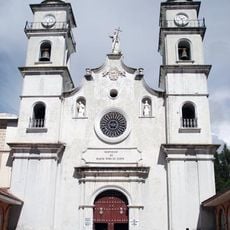
Capilla Cristo Pobre is a neo-Gothic church in Jauja, Junín, built between 1920 and 1928 to a design by the French priest Louis Grandin Blottieere. Its light grey carved facade has two symmetrical towers with tall pointed-arch openings, a gabled central peak topped by a cross, and a wooden double door in the main portal. The vault rises 11.7 m and the towers reach 20 m.
Capilla Cristo Pobre was built between 1920 and 1928 and blessed on 15 June 1922 by Monsignor E. Lisson, with Augusto B. Leguía and his wife Lola as godparents. The French priest Louis Grandin Blottieere, of the Jauja parish, designed it as a neo-Gothic replica of Notre-Dame de Paris. It was first meant as a shelter for tuberculosis patients arriving at the Domingo Olavegoya sanatorium, and was declared National Cultural Heritage on 9 July 2010.
The chapel is run by the Hijas de la Caridad, and its wooden altar is dedicated to the Virgen Milagrosa. Around it hang French paintings of the Via Crucis and statues of Cristo Pobre and of Saint Vincent de Paul, the French priest honoured in the facade sculptures.
The chapel stands in central Jauja at the corner of San Martín and Colina streets, beside the Hospital Domingo Olavegoya and the Colegio Nacional de Mujeres San Vicente de Paúl, a short walk from the Plaza de Armas. An iron grille surrounds the building. Jauja sits at roughly 3,400 m, so allow time to adjust to the altitude.
The chapel was built between 1920 and 1928 to shelter tuberculosis patients arriving in Jauja for the Domingo Olavegoya sanatorium, and it was blessed on 15 June 1922 by Monsignor E. Lisson, with President Augusto B. Leguía and his wife Lola as godparents. It was declared a National Cultural Heritage site on 9 July 2010.
The community of curious travelers
AroundUs brings together thousands of curated places, local tips, and hidden gems, enriched daily by 93,424 contributors worldwide.