Cárcel Municipal de Guayaquil, Former municipal prison in Guayaquil, Ecuador
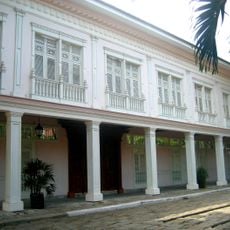
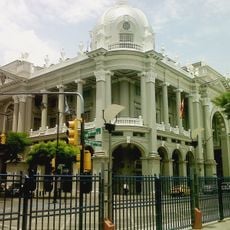
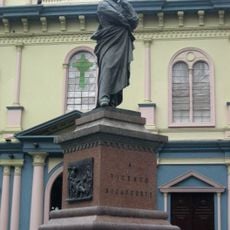
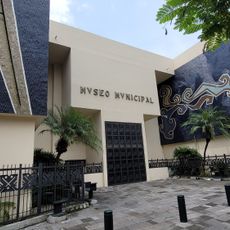
The Cárcel Municipal de Guayaquil is a cloister-type building with a central courtyard, a perimeter gallery and more than 40 cells and dungeons around it. Its flat facade is split into two bodies by a cornice, with pilasters and a symmetrical row of semicircular-arched windows, topped by a flat cornice. Its pilings and slabs were reinforced concrete imported from Genoa, Italy.
The building was constructed between 1903 and 1905 by engineer Francisco Manrique Pacanis and replaced an earlier prison destroyed in the great fire of 1896. It served as a prison until 1966, when it ceased its original function.
The street outside was long called Calle de los Lamentos, the Street of Laments, because the Civil Hospital, the amphitheater and the General Cemetery stood beside the jail. Inside, inmates included Enrique Lituma, "El hombre rata", who robbed jewelry stores through pipes, and Víctor González, "El come-muerto", a gravedigger who exhumed bodies to sell their clothes and jewels.
The building is located at the intersection of Julian Coronel and Baquerizo Moreno streets in the city center. It is maintained by the Ecuadorian Social Security Institute and the Guayaquil XXI Foundation, placing it under institutional care.
The reinforced concrete pilings and slabs were imported from Genoa, Italy, and the building is considered the city's first structure made with cement. The National Institute of Cultural Heritage declared it heritage by agreement no. 2757, largely for that reason.
The community of curious travelers
AroundUs brings together thousands of curated places, local tips, and hidden gems, enriched daily by 93,772 contributors worldwide.