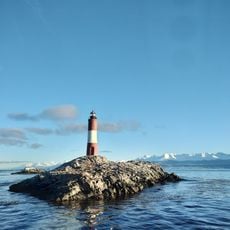
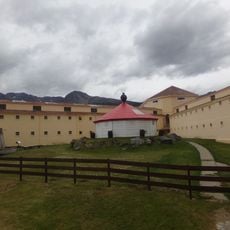
Año Nuevo Lighthouse, Maritime navigation beacon in Departamento Ushuaia, Argentina.
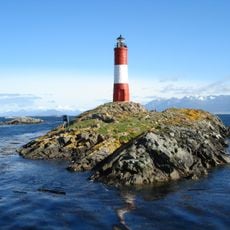
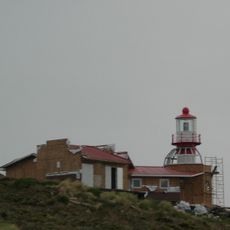
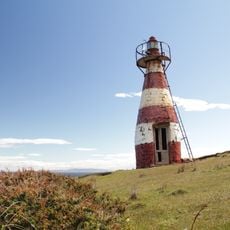
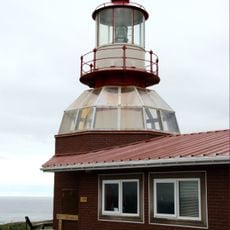
Año Nuevo Lighthouse is a 23.5-metre tower on Isla Observatorio, painted in horizontal white and grey bands, with the former keeper's house of red brick at its base. Its focal plane stands 65.5 metres above sea level and it emits three white flashes, separated by 8 seconds, in a 32-second period, reaching 39 km. It has operated since 1 October 1902 and runs on solar panels.
At the 1899 International Geographical Congress in Berlin, the Royal Geographical Society and the British National Antarctic Expedition asked Argentina to build a lighthouse, weather station and magnetic observatory to help Antarctic expeditions check their instruments. Argentina chose the Año Nuevo islands, and the site opened in 1902. Jean-Baptiste Charcot on the Français and Otto Nordenskjöld on the Antarctic visited; the station and observatory were dismantled in 1917.
The lighthouse is managed by Argentina's Servicio de Hidrografía Naval. Its site was inaugurated in 1902 after the Royal Geographical Society and the British National Antarctic Expedition asked Argentina at the 1899 Berlin geography congress for a lighthouse, weather station and magnetic observatory to help Antarctic expeditions check their navigation instruments.
This lighthouse sits on an island and is best visited by boat when sea conditions are calm and weather is clear. Visitors should plan their visit around the unpredictable weather patterns typical of this southern region.
The light's three white flashes, each 8 seconds apart over a 32-second period, reach 39 km (about 21 nautical miles). The tower replaced the San Juan del Salvamento light, which Jules Verne made famous as the Lighthouse at the End of the World.
The community of curious travelers
AroundUs brings together thousands of curated places, local tips, and hidden gems, enriched daily by 94,679 contributors worldwide.