Parque Saavedra, Public park in Saavedra, Buenos Aires, Argentina
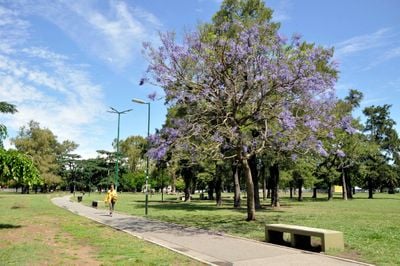
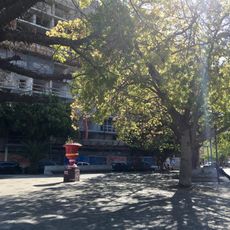
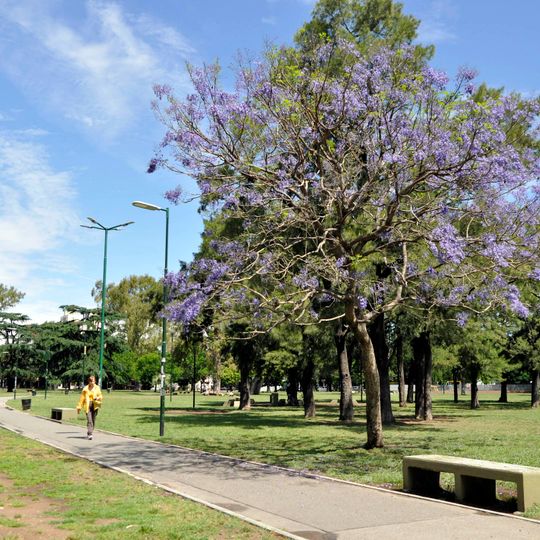
Parque Saavedra is a park in the Saavedra neighbourhood of Buenos Aires, with a perimeter of 1.28 km. A pale grey paved walkway crosses level lawns, lined with tall lampposts and trees that bear clusters of light purple blossoms; a low concrete bench with dark openings beneath stands near the path. Inside the grounds are a state school, a sports centre with a swimming pool, a carousel, a bocce court and a tools shed.
Luis María Saavedra bought land north of Buenos Aires in the mid-19th century and settled there in 1864; the chacra's main house was begun around 1870 and finished around 1880, with a lake that still exists. After his widow Dámasa Zelaya died on 23 November 1929, the national government expropriated the Saavedra Zelaya succession's lands by Law 12.336. The park is among the city's oldest, inaugurated two years before Parque 3 de Febrero.
The park was first named Paseo del Lago for the lake at its centre, fed by the Medrano stream, now channelled underground. A carousel and a bocce court remain in use, and on Thursdays a small fair sells meat, fish, fruit and vegetables; at weekends other stalls set up.
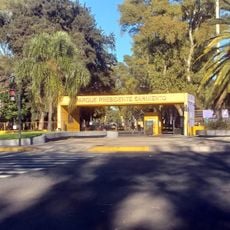
The park has a perimeter of 1.28 km, with entrances on Pinto street marked since the late 1990s by monuments with lion figures and plants. A paved walkway crosses the lawn past concrete benches and tall lampposts. On Thursdays a small market sells meat, fish, fruit and vegetables; on weekends other stalls set up.
The park was first named Paseo del Lago, because a lake fed by the Medrano stream lay at its centre; the stream now runs underground in a pipe. In 1890 its flowerbeds saw a plan to canalise the Medrano and turn it into a second port for the city, with an immigrants' hotel to be built on what is now parkland.
The community of curious travelers
AroundUs brings together thousands of curated places, local tips, and hidden gems, enriched daily by 94,356 contributors worldwide.