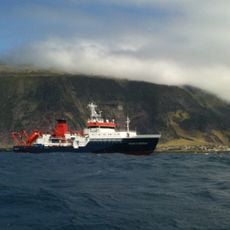
Mount Olav, Mountain summit in Tristan da Cunha, Saint Helena, Ascension and Tristan da Cunha.
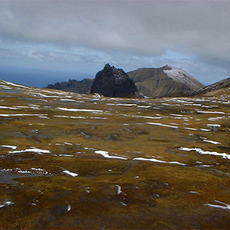
Mount Olav is the second highest peak on the remote island group of Tristan da Cunha in the South Atlantic, rising about 1,967 meters (6,453 feet) above sea level. The summit is part of a volcanic landscape made of dark rock and steep slopes.
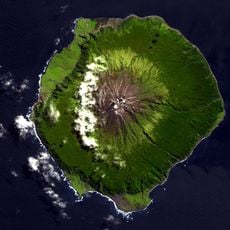
Mount Olav is a scoria and ash cone of pyroclastic sediment, one of several such cones that together with Queen Mary's Peak form an active shield volcano on Tristan da Cunha. A ridge links it directly to Queen Mary's Peak, the highest point in the South Atlantic. At 1,967 m it is the second-highest summit in the British Overseas Territory of Saint Helena, Ascension and Tristan da Cunha.
The name recalls Olav, the Norwegian king later canonised as Saint Olav, though the sources give no account of who named the peak or when. The summit is one of several scoria and ash cones of pyroclastic sediment that, together with Queen Mary's Peak, form an active shield volcano.
Mount Olav lies about 5.6 km north of Edinburgh of the Seven Seas, the island's only settlement, and is reached on foot from there; no road or lift serves the cone. The summit stands 1,967 m above the sea, so the climb crosses several climate bands, from wooded lower slopes to cold, wet upper ground. Rain falls on roughly 1,252 mm a year and temperatures average about 10 °C, with August near 4 °C.
Mount Olav is the only volcanic cone that, together with Queen Mary's Peak and other summits, forms an active shield volcano; all these summits are scoria and ash cones of pyroclastic sediment. A ridge connects Mount Olav directly to Queen Mary's Peak, the highest point in the South Atlantic.
The community of curious travelers
AroundUs brings together thousands of curated places, local tips, and hidden gems, enriched daily by 94,629 contributors worldwide.