San Lorenzo Church, Potosí, Andean Baroque church in Potosí, Bolivia
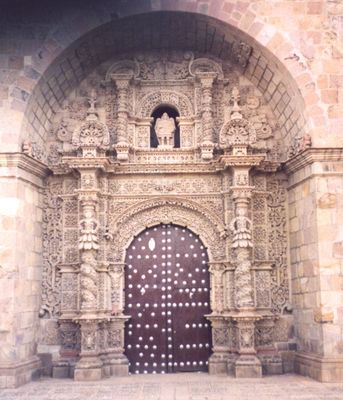
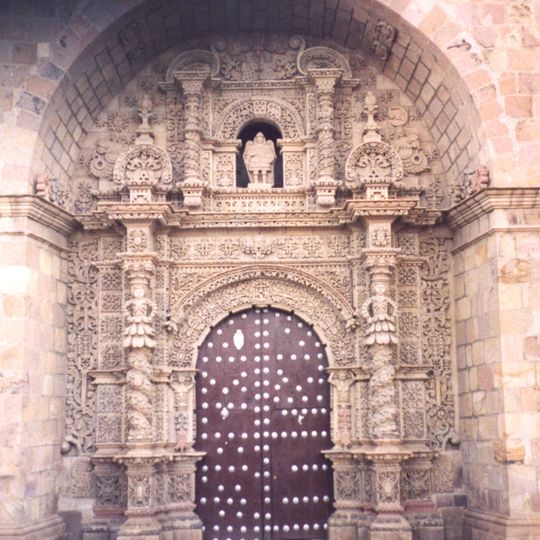
San Lorenzo Church is a stone church in Potosí whose facade is framed by a rounded arch and a tall dark wooden double door covered in rows of round metal studs. Carved stacked columns with human figures and swirling reliefs flank the entrance, and a small niche above the door holds a sculpted figure. The retablo portal was cut in diorite between 1728 and 1744, with acanthus leaves, cherubs, garlands and geometric motifs set like a mosaic.
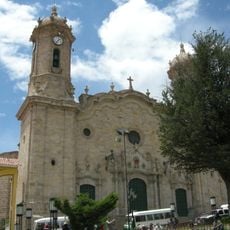
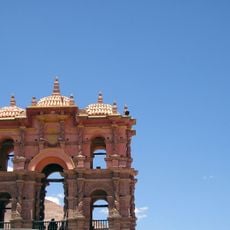
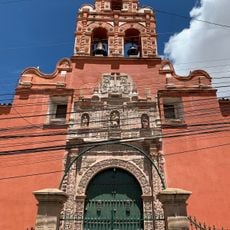
Construction began in 1548 as La Anunciación, one of Potosí's first churches, and finished in 1552 after a cedar shortage; a heavy snowfall collapsed it ten years after work began, forcing repairs. In 1572 Viceroy Toledo renamed it San Lorenzo de Carangas for the Carangas indigenous people, and it later became an Indian parish. Its main remodelling came in the 18th century, when the dome was raised and the carved stone portada was made between 1728 and 1744.
The parish held a venerated image of the Santo Cristo Crucificado, honoured with processions and novenas recorded in 1719 during an epidemic and in 1729 during a drought. At least one confraternity, that of the Santísimo Sacramento, existed here. In 1809 Caranga-descended criollos defended their belonging to San Lorenzo against reassignment to the Tarapaya doctrine, citing an "antiquísima" possession.
Visitors should dress modestly out of respect for the religious setting. The church maintains regular opening hours, so it is accessible during standard business times.
The carved stone portal was made between 1728 and 1744, and the dates are cut into the stone above the two figures of Saint Lawrence. The upper section shows the Sun and Moon at the same level, which some scholars read through Aymara cosmology. Look for the mermaid figures on the facade, whose meaning is still debated.
The community of curious travelers
AroundUs brings together thousands of curated places, local tips, and hidden gems, enriched daily by 92,805 contributors worldwide.