Campos Gerais National Park, Protected area in Carambeí, Brazil
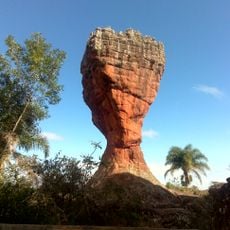
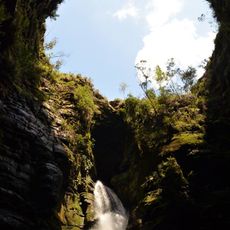
Campos Gerais National Park covers 21,299 hectares of Atlantic Forest biome across Ponta Grossa, Castro and Carambeí in Paraná. Its terrain holds cliffs, canyons, faults and caves, with mixed forest and grassland, and it contains the main sources of the Tibagi and Ribeira de Iguape rivers. The Buraco do Padre is a subterranean amphitheatre 30 metres across with a 45-metre waterfall.
The park was created by federal decree on 23 March 2006, covering about 21,300 hectares in the municipalities of Ponta Grossa, Castro and Carambeí. It is managed by the Chico Mendes Institute for Biodiversity Conservation (ICMBio). Its stated aims are to protect remnants of mixed ombrophilous forest and southern grasslands, support scientific research, and develop environmental education and ecological tourism.
Rock paintings are found along the park's trails, and the Buraco do Padre waterfall has plant species growing on its walls. The park also protects one of the southernmost outliers of the cerrado biome in Brazil, at Cachoeira da Mariquinha, where researchers recorded 26 cerrado species between 2006 and 2008.
The park is managed by ICMBio and spans Ponta Grossa, Castro and Carambeí. Some attractions, such as Buraco do Padre, Setor Macarrão and Cachoeira do São Jorge, have parking, toilets, snack bars, camping areas and signage, and charge an entrance fee; others have no infrastructure. The terrain includes cliffs, canyons, faults and caves, so plan footwear and timing accordingly.
The park protects the source waters of two major rivers, the Tibagi and Ribeira de Iguape, which flow far beyond its boundaries. This role as a water source makes the area significant to the broader landscape and communities downstream.
The community of curious travelers
AroundUs brings together thousands of curated places, local tips, and hidden gems, enriched daily by 93,134 contributors worldwide.