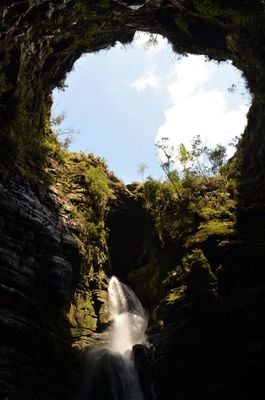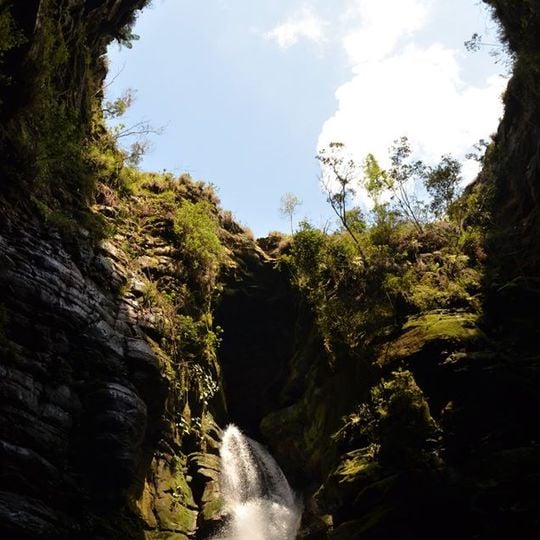
Buraco do Padre, Cave formation in Ponta Grossa, Brazil
Buraco do Padre is a furna in the Furnas Formation sandstone, about 24 km east-southeast of Ponta Grossa in Itaiacoca. Its walls form a vertical chute where the Quebra-Pedra River drops as a waterfall into a shadowed pool. The opening lets in natural light, revealing cross-stratified and plane-parallel sandstone layers.
The cave formed over millions of years through natural water erosion in the sandstone layers beneath Ponta Grossa. Continuous flow gradually carved out the hollow shaft and the waterfall you see today.
The name Buraco do Padre is attributed to Jesuit priests of the 17th or 18th century, who are said to have used the cave for meditation, retreat or shelter on journeys inland. Other accounts credit the caboclos and tropeiros who crossed the region, who may have known it as a resting or hiding place. Oral tradition links the site to the evangelisation of Indigenous populations.
The site is reached by a walking path, and entering the cave involves some climbing over rocks. Wear sturdy shoes since the surfaces can be slippery, especially near the waterfall.
The cave sits where geological faults and fractures cut the sandstone of the Furnas Formation, and underground erosion along them opened the shaft. Inside, the walls show the formation's cross-stratification and plane-parallel bedding. Since 2002 the site has been listed among Brazil's geological sites by the Brazilian Commission of Geological and Paleobiological Sites.
The community of curious travelers
AroundUs brings together thousands of curated places, local tips, and hidden gems, enriched daily by 94,457 contributors worldwide.