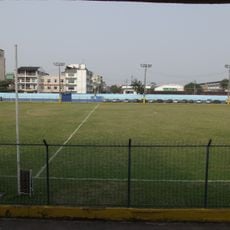
Estádio da Rua Bariri, Football stadium in Olaria, Rio de Janeiro, Brazil.
Estádio da Rua Bariri is a football stadium with concrete stands and a grass playing field located in a residential area of Rio de Janeiro. The venue accommodates around 8,300 spectators and features a straightforward layout where fans sit very close to the action.
The land at Rua Bariri 251 belonged to Custódio Nunes, who kept cattle there for the Irmãos Goulart slaughterhouse and let the Irmãos Goulart club play on the field; in 1925 his daughter Noêmia donated it to Olaria Atlético Clube. The stadium opened on 6 April 1947 with a match between Fluminense and Vasco da Gama, won by Fluminense; Vasco's Friaça scored the ground's first goal. Its attendance record of 18,000 was set on 30 April 1997 in Flamengo's 3-1 win over Bangu.
Bariri means "rapid" in a Tupi-Guarani language, the name of the street where the ground stands. In the stadium's first year, Botafogo brought its mascot, the dog Biriba, and Olaria answered with a 60-year-old indigenous man who set his macaw on the dog, which ran off. A group of 30 to 40 local taxi drivers, the "Terceiro Time", backed the club and intimidated opponents.
The stadium sits on Bariri Street in the Olaria neighborhood and is accessible by public transport. Visitors should expect a compact venue where spaces can feel crowded during matches, so arriving early helps secure a good spot.
The ground carries the nickname 'Alçapão da Bariri', reflecting how difficult it is for visiting teams to win matches here. The close proximity between spectators and the playing field creates an intense home-field advantage that surprises many opponents.
The community of curious travelers
AroundUs brings together thousands of curated places, local tips, and hidden gems, enriched daily by 92,785 contributors worldwide.