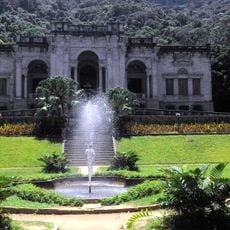
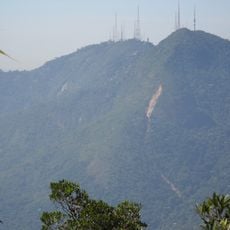
Chapel of Our Lady of Cabeça, Colonial chapel in Jardim Botânico, Brazil.
The Chapel of Our Lady of Cabeça stands on the grounds of the Casa Maternal Mello Mattos, on the slope of Rio de Janeiro's Botanical Garden. Its simple facade has a triangular pediment, stone door and window surrounds, two barred windows and a panelled wooden door, reached through a porch on two Tuscan columns. Inside is a single room with clay-tile flooring under a barrel-vaulted brick ceiling and an 18th-century polychrome wood altar.
The chapel was built during the Portuguese colonial period and has shaped Rio de Janeiro's religious landscape ever since. In 1965 it received official protection as a heritage asset by Brazil's national heritage institute.
The devotion to Nossa Senhora da Cabeça was brought from Portugal by the Correia de Sá family, and the cult was begun by governor Martim Correia. The chapel was built beside the casa-grande of the Engenho d'El Rei sugar plantation, following the colonial practice of private estate chapels. Its 18th-century polychrome wood altar survives inside.
The chapel stands on the grounds of the Casa Maternal Mello Mattos, on the slope of the Jardim Botânico, and is reached by a stairway leading to a porch supported by two Tuscan columns. Access is through that porch, so the entrance is not at street level. The building is a single room with a barrel-vaulted ceiling, and the floor level has changed over time.
Archaeological digs begun in 2005 ahead of restoration found fragments of porcelain, glass and other objects from the farm and sugar mill that operated here in the 18th and 19th centuries, buried beside the wall to the right of the chapel. A layer of sand and stones near the steps of the churchyard suggests where the separate bell tower once stood.
The community of curious travelers
AroundUs brings together thousands of curated places, local tips, and hidden gems, enriched daily by 94,293 contributors worldwide.