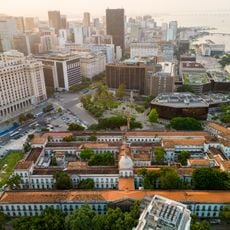
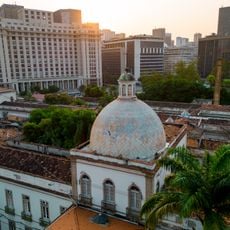
National Historical Museum, National history museum at Praça Marechal Âncora, Centro, Rio de Janeiro, Brazil
The National Historical Museum occupies the former Calabouço Point complex in Centro, Rio de Janeiro, made up of the 1603 Fort of São Tiago foundations, the 1693 Calabouço Prison, the 1762 Casa do Trem, the 1764 War Arsenal and the 1835 Barracks. Its 14,540 m² of exhibition space plus 3,212 m² of courtyards include the Pátio dos Canhões, the Pátio da Minerva and the Pátio de Santiago. The white building with a red tile roof and the sign "MUSEU HISTORICO NACIONAL" is one of these structures.
The site was a point of land between Piaçaba and Santa Luzia beaches where the Portuguese built the Fort of São Tiago da Misericórdia in 1603. The Calabouço Prison for enslaved people followed in 1693, the Casa do Trem weapons depot in 1762, the War Arsenal in 1764 and the Barracks in 1835. The military complex remained until 1908, and in 1922 the museum opened during the Independence Centennial Exhibition.
The museum's name comes from its 1922 founding as a national history museum, and its first director was the lawyer and journalist Gustavo Barroso. The long-term galleries are named Oreretama, Portuguese in the World, The Construction of the State and The Construction of Citizenship, tracing Brazil from its earliest peoples to the present.
The museum opens on weekdays in the morning and afternoon, and on weekends only in the afternoon, with guided tours offered during opening hours. The rooms are accessible via staircases and some ramps, and a visit typically takes two to three hours.
The Casa do Trem, now housing the numismatic collection, is where the body of Tiradentes is said to have been quartered after his execution at Campo da Lampadosa in the late 18th century. The museum's library holds over 57,000 titles, some dating to the 15th century.
The community of curious travelers
AroundUs brings together thousands of curated places, local tips, and hidden gems, enriched daily by 94,390 contributors worldwide.