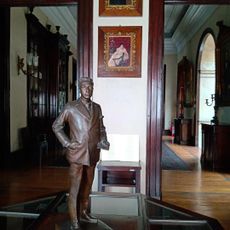
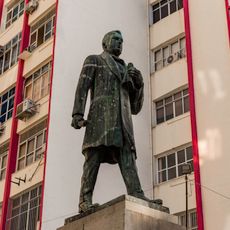
Palace of Itamaraty, Neoclassical palace in Centro, Rio de Janeiro, Brazil
The Palace of Itamaraty is a strictly symmetrical neoclassical building begun in 1851 and completed in 1855, designed by José Maria Jacinto Rebelo, a disciple of Grandjean de Montigny. At the rear, a water mirror flanked by imperial palms extends the composition. Between 1927 and 1930, Joseph Gire, Robert Prentice and Anton Floderer renovated structures around the courtyard in a Beaux-Arts neoclassical style, adding the library and altering the facade.
The palace was built between 1851 and 1855 for Francisco José da Rocha Leão, Count of Itamaraty, son of the first Baron of Itamaraty, to designs officially attributed to José Maria Jacinto Rebelo. It served as the seat of the republican government from 1889 to 1898 and housed the Ministry of Foreign Affairs from 1899 to 1970, which gave the ministry its nickname Itamaraty. It was the eighth building listed as a national monument in Brazil, in 1938.
The name Itamaraty became the official nickname of Brazil's Foreign Ministry because the palace housed it from 1899 to 1970. The name itself comes from Tupi-Guarani, with suggested meanings such as "river of small stones" (itá, stone; mirim, small; ty, river). Today the building holds the Historical and Diplomatic Museum, the Historical Archive and the Map Library.
The palace now houses the Foreign Ministry's Rio de Janeiro representative office, the Historical and Diplomatic Museum, the Historical Archive and the Map Library, plus the UN Information Office in Brazil. The building was listed as a national monument in 1938, the eighth in Brazil. Check opening arrangements for the museum and archive before planning a visit.
The palace was the eighth building listed as a national monument in Brazil, in 1938. Its name became the official nickname of the Foreign Ministry itself, which occupied the building for seven decades.
The community of curious travelers
AroundUs brings together thousands of curated places, local tips, and hidden gems, enriched daily by 92,929 contributors worldwide.