Royal Portuguese Cabinet of Reading, Neo-Manueline library in Centro, Rio de Janeiro, Brazil
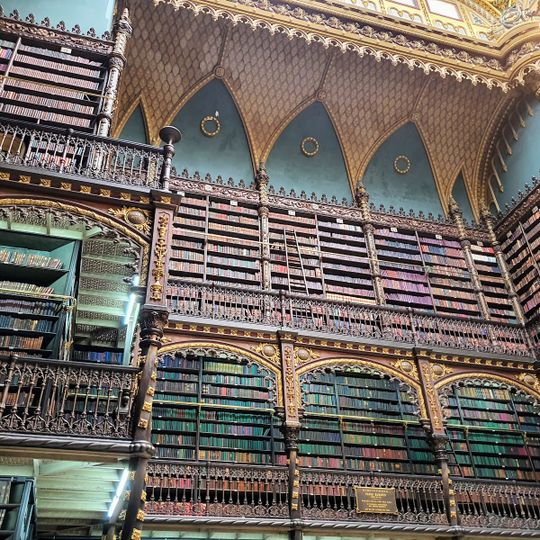
The Royal Portuguese Cabinet of Reading occupies a Neo-Manueline building on Rua Luís de Camões in downtown Rio de Janeiro. Its pale stone facade, inspired by Lisbon's Jerónimos Monastery, carries four statues of Pedro Álvares Cabral, Luís de Camões, Infante D. Henrique and Vasco da Gama, and medallions of writers Fernão Lopes, Gil Vicente, Alexandre Herculano and Almeida Garrett. Inside, the Reading Room has wooden shelves, a chandelier and an iron-framed skylight, the first of its kind in Brazil.
Founded in 1837 by forty-three Portuguese immigrant political refugees, the institution was the first association of that community in Rio de Janeiro. Emperor Pedro II laid the cornerstone of its Neo-Manueline headquarters on 10 June 1880, and Princess Isabel with the Count of Eu inaugurated it on 10 September 1887. The facade, carved in lioz stone in Lisbon by Germano José Salle, was shipped to Rio.
The library carries its Portuguese identity through the collections and the community it has served since the 1800s. Visitors encounter the lasting connection between Rio and the Portuguese-speaking world, with the space functioning as a cultural anchor for those seeking knowledge of their heritage.
The library is situated in the heart of downtown Rio and welcomes visitors during daytime hours on weekdays for exploring the reading rooms. The layout is straightforward, with a main floor offering direct access to the impressive interior despite the building's compact street presence.
The first five solemn sessions of the Brazilian Academy of Letters, presided over by Machado de Assis, were held in this building. A manuscript of his comedy "Tu, só tu, puro amor" is among the holdings, alongside a 1572 princeps edition of Os Lusíadas.
The community of curious travelers
AroundUs brings together thousands of curated places, local tips, and hidden gems, enriched daily by 92,598 contributors worldwide.