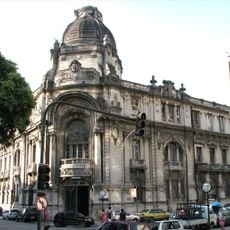
Praça Tiradentes, Portuguese colonial square in Centro, Rio de Janeiro, Brazil.
Praça Tiradentes is a square in downtown Rio de Janeiro whose centerpiece is the 1862 equestrian statue of Dom Pedro I, designed by João Maximiano Mafra and cast by French sculptor Louis Rochet. The monument rises 15.7 meters from a stone base through a column with allegorical groups to the bronze rider. Four cast-iron statues of Justice, Liberty, Union and Fidelity, made at the Val d'Osne foundry, stand nearby.
The square began in the 17th century as Rossio Grande, split off from Campo de São Domingos. It was later called Campo dos Ciganos and Campo da Lampadosa after the 1747 church. In 1808 a pelourinho gave it the name Campo do Polé, and in 1821 it became Praça da Constituição. It took its current name in 1890 for the Tiradentes centenary.
The name honors Tiradentes, executed in 1792 near the square at the corner of Rua Senhor dos Passos and Avenida Passos. In the 19th century the square was the city's leisure center, home to the Teatro São Pedro de Alcântara, the Maison Moderne café-concert and the Stadt Munchen restaurant, open until dawn for theatergoers. Soprano Bidu Sayão lived at number 48.
The square is easily reached by multiple bus lines and metro stations, with direct access to museums, theaters, and restaurants in the Centro district. Its central location makes it simple to move between different attractions and explore other parts of the historic city.
The equestrian statue of Pedro I, inaugurated in 1862, was designed by João Maximiano Mafra and cast in France by Louis Rochet on the order of Emperor Pedro II. It stands 15.7 m tall, with a 3.30 m stone base, a 6.40 m column bearing allegorical groups and a 6 m bronze horse and rider. The surrounding iron railing alternates the imperial crown with the name Pedro I.
The community of curious travelers
AroundUs brings together thousands of curated places, local tips, and hidden gems, enriched daily by 93,466 contributors worldwide.