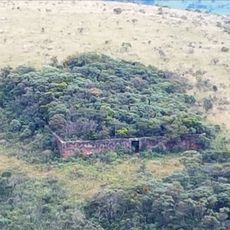
Casa de Pedra do Gambá, archaeological site in Brazil
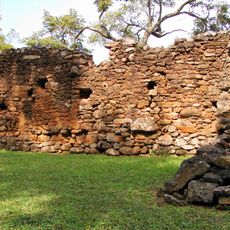
Casa de Pedra do Gambá is the oldest building of the archaeological site on the right bank of the Gambá stream, in the Serra do Gambá, rural São José das Mercês, north of Entre Rios de Minas. Built in 1701, its walls are entirely of stone, and its doors and windows pivot on wooden pegs fitted into cylindrical sockets cut in the stone sills and lintels, since iron was scarce.
The Casa de Pedra do Gambá was built in 1701 as the first headquarters of the site, by sertanistas remaining from Fernão Dias's expeditions in the Paraopeba river valley. In the last decades of the 17th century Fernão Dias had left São Paulo with forty paulistas and two hundred indigenous people seeking emeralds in the Sertão dos Cataguás. Near the Paraopeba, the expedition set up the Fortim dos Bandeirantes in the Serra do Gambá, built of local stones for lack of iron fittings. In 1713 the Portuguese Pedro Domingues and Bartolomeu Machado founded the arraial do Brumado, later Entre Rios de Minas.
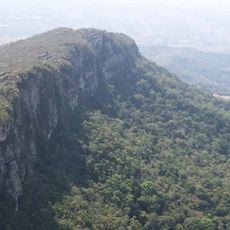
The name Gambá comes from the stream and mountain range beside the ruins; the report of 1912 also records the old spelling Suassuhy, meaning "river of the deer". The site lies in the rural cluster of São José das Mercês, and the 2014–2017 archaeological project included talks and educational material for pupils of the surrounding public schools.
The ruins stand on the right bank of the Gambá stream, in the rural cluster of São José das Mercês, reached by a hike through the Gambá range; a local guide from the cluster leads the way. The site was cleaned, delimited and signposted during the 2014–2017 archaeological project, with structures shored up and stabilized. The surrounding area lies within the industrial district's zone of influence in Jeceaba, so access should be arranged beforehand.
The 1912 report by engineer Álvaro A. da Silveira notes that the doors and windows pivot on wooden pegs fitted into cylindrical holes cut in the stone lintels and sills, a solution adopted because iron was hard to obtain in the region. The house was built in 1701 and was still described as in perfect condition then.
The community of curious travelers
AroundUs brings together thousands of curated places, local tips, and hidden gems, enriched daily by 92,798 contributors worldwide.