Bisnau Archaeological Site, Archaeological site near Bezerra district, Formosa, Brazil
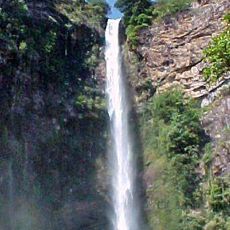
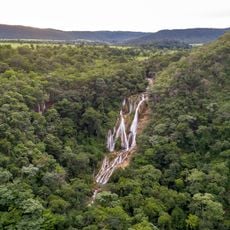
The Bisnau Archaeological Site is a 2,600-square-metre wall of sedimentary sandstone on a private farm in Formosa, Goiás, 120 km from Brasília along the BR-020. Its surface holds hundreds of low-relief rock inscriptions carved by prehistoric Amerindian peoples. Open and closed cerrado, plateaus and the 130-metre Bisnau or Capetinga waterfall, 500 metres away, surround it.
The site's hundreds of low-relief petroglyphs were made by prehistoric Amerindian peoples between roughly 4,500 and 11,000 years ago, at the end of the Paleo-Indian period and the start of the Archaic period. The same region holds 29 other archaeological sites with petroglyphs whose meanings remain unexplained.
The markings are low-relief petroglyphs carved into a sandstone wall, not paintings, and no black pigment is described in the sources. Local people and visitors have read the hundreds of carvings as astronomical orientations, and some have even suggested extraterrestrial contact; scientists and students continue to debate their meaning. Chalk scribbles left by vandals now cover part of the rock.
The site lies on a private farm in Formosa, Goiás, 120 km from Brasília along the BR-020, just past the Bezerra settlement. Access requires the owner's permission, so arrange the visit in advance. The Bisnau waterfall, also called Capetinga, is 500 m from the rock wall. Rain strips layers from the sandstone, and chalk scribbles are a recurring problem.
The site lies on private farmland, so access depends on the owner's permission. Rain peels layers off the sandstone wall, and vandals have covered the carvings with chalk scribbles. About 500 m away, the Bisnau or Capetinga waterfall drops more than 130 m.
The community of curious travelers
AroundUs brings together thousands of curated places, local tips, and hidden gems, enriched daily by 92,818 contributors worldwide.