Elevador Lacerda, Public elevator in Salvador, Brazil
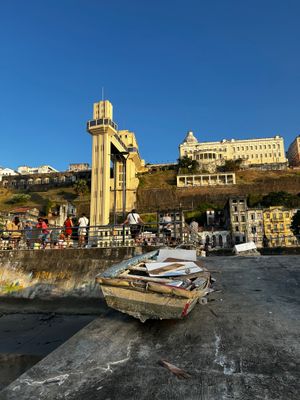
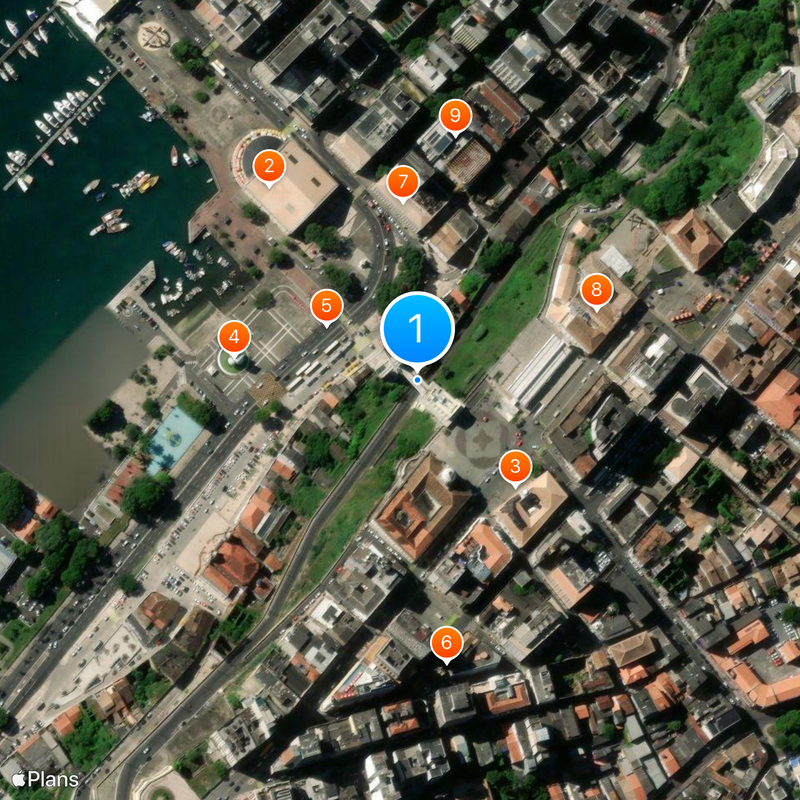
Elevador Lacerda is a public elevator in Salvador connecting Praça Cairu in the Cidade Baixa to Praça Tomé de Sousa in the Cidade Alta. Its two towers rise 72 metres: one pierces the rock of the Ladeira da Montanha, the other descends to the lower level. The 1930 Art Deco structure has four electrified cabins carrying 27 passengers each.
Antônio de Lacerda's plan for a hydraulic lift, first called Elevador Hidráulico da Conceição, began construction on 17 October 1869 and opened on 8 December 1873, when its 63-metre tower was the world's tallest elevator. It ran on hydraulic power until 1906, when the Linha Circular de Carris da Bahia electrified it. The 1930 overhaul added two lifts and a new tower in Art Deco style, giving the present 72-metre structure, inaugurated on 7 September 1930. IPHAN listed it on 7 December 2006.
The elevator was popularly nicknamed "Parafuso" (Screw) in its early years; the official name only became Elevador Lacerda in 1896, honouring its conceiver and builder Antônio de Lacerda. The 1963 song "Retrato da Bahia" by Riachão, recorded by Trio Nordestino, describes it rising and descending from Cairu Square as a portrait of Bahia.
The elevator runs between Cairu Square in the Lower City and Tomé de Sousa Square in the Upper City; the ride takes about 30 seconds. The visible tower descends to the Lower City level, while the second shaft pierces the rock of Ladeira da Montanha. Cabins hold 32 passengers each.
The elevator was popularly nicknamed "Parafuso" (Screw) in its early years, and the official name only became Elevador Lacerda in 1896, honoring its conceiver Antônio de Lacerda. In 1963 the Trio Nordestino recorded Riachão's song "Retrato da Bahia", whose lyrics describe the elevator rising and descending at Praça Cairu.
The community of curious travelers
AroundUs brings together thousands of curated places, local tips, and hidden gems, enriched daily by 92,722 contributors worldwide.