Fort of Saint Peter, Military fortress in Salvador, Brazil
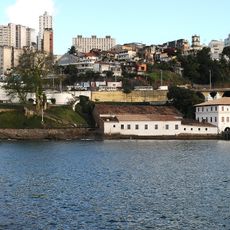
The Fort of Saint Peter is a quadrangular stone-and-lime fort with pentagonal bastions at its corners, built in the Vauban style. Its low, one-storey buildings surround a central cistern, and the bastion tips carry turret-like guaritas topped with domes. A low-arched gate with a tribune above it opens through the walls.
A first entrenchment on the site dates from the Dutch invasion of 1624, chosen to block the south-western land access to Salvador and named after the nearby Church of São Pedro, later demolished. Construction of the fort began in 1627 under governor-general Diogo Luís de Oliveira, using wattle and earth and armed with 35 guns. From 1646, under Antônio Teles da Silva, it was rebuilt in stone and lime as a quadrangular polygon with pentagonal bastions in Vauban style.
The fortress stands as a mark of Portuguese settlement in Brazil, showing how European defensive techniques were adapted for this coastal location. Its stone design and four-bastion system reveal the builders' concern for protection from naval threats.
The fort stands near the Passeio Público, and its former moat strip was requested by that garden's director in the 1850s for planting. Visitors enter through a low-arched stone gate topped by a tribune-like structure; the terreplein is ringed by single-storey buildings around a central cistern. Look for the corner turrets with domed cupolas on the bastions.
The fort's name came from the Church of São Pedro that stood nearby; the church was demolished because of the fort. In 1798 the Conjuração Baiana conspirators, including soldiers Lucas Dantas and Luís Gonzaga and tailors João de Deus and Manuel Faustino, met inside its walls.
The community of curious travelers
AroundUs brings together thousands of curated places, local tips, and hidden gems, enriched daily by 92,813 contributors worldwide.