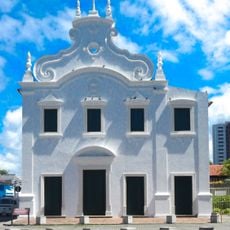
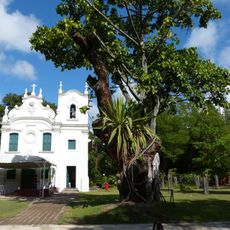
Arraial Velho do Bom Jesus, Military fortress in Pernambuco, Brazil.
Arraial Velho do Bom Jesus was an entrenched camp with an irregular perimeter, built on a private property, probably a sugar mill, about six kilometres west of Olinda and Recife on the Capibaribe River. Its walls and moat were one and a half lances deep and high, with vertical sides, and a packed-earth walkway divided the moat in two. Possibly designed by Cristóvão Álvares, it was a rustic but extremely solid work.
Built in 1630, the fortress served as a command center under Matias de Albuquerque's leadership against Dutch occupation forces. A three-month siege in 1635 led to its capture and the end of Portuguese control at this location.
The name Bom Jesus do Arraial links the fortified camp to its patron, while the site is remembered for the 547 combatants, including Henrique Dias, who surrendered on 8 June 1635. Excavations by the Federal University of Pernambuco recovered part of the moat, wall bases and a large quantity of ammunition and personal objects of the fighters.
The site is located in the Casa Amarela neighborhood of Recife along Estrada do Arraial. Visitors should be prepared to see mainly archaeological remains rather than intact structures or walls.
Emperor Pedro II visited this location in 1859 and searched for the fortress remains, but found no visible traces. This shows how completely the structure had disappeared under soil and vegetation by that time.
The community of curious travelers
AroundUs brings together thousands of curated places, local tips, and hidden gems, enriched daily by 92,861 contributors worldwide.