Gravity Discovery Centre, Science museum and nonprofit organization in Gingin, Australia.
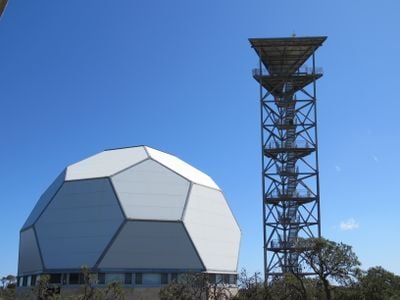
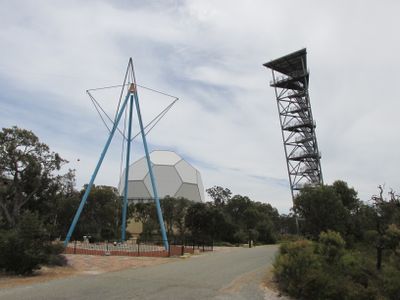
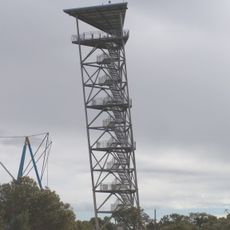
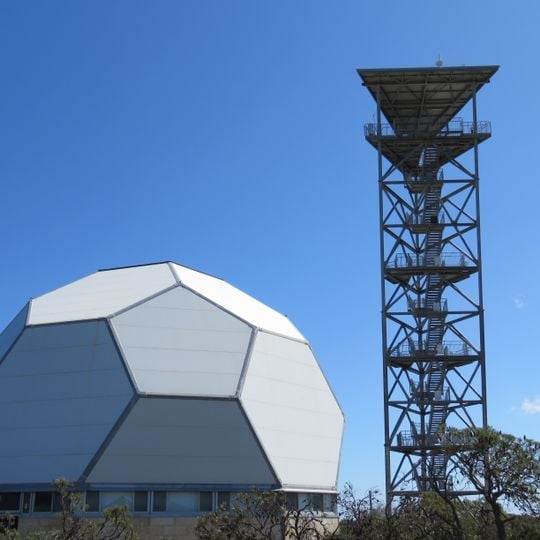
The Gravity Discovery Centre is a science museum and observatory in bushland near Gingin, Western Australia. Its Cosmology Gallery is topped by a 20-metre (66 ft) geodesic dome of pale grey triangular panels. Beside it stands a tall steel lattice tower with an observation platform, zigzagging internal stairs and a small antenna, and a light-blue steel tripod structure with a triangular frame stands within a low circular picket fence.
The search for gravitational waves began in the 1990s, and NIOBE, a niobium-bar detector built by Professor David Blair's team at UWA, came into operation in 1993 after 16 years, 12 PhD projects and several million dollars. It was one of five detectors set up worldwide and reached world-record sensitivity. In 2005 John de Laeter and David Blair received the Eureka Prize for promoting public understanding of science, recognising the creation of the Gravity Discovery Centre.
The name refers to gravity research, while visitors today experiment at stations with exhibits on magnetism, air pressure, and space flight. The centre combines physics experiments with insights into native flora and fauna, so school groups and families can be hands-on.
The centre lies about an hour north of Perth and offers parking as well as outdoor areas to explore. The tower requires climbing 222 steps, so visitors should bring stamina and sturdy footwear.
A one-kilometre walk presents a scale model of the solar system with plaques at each planet, showing the spatial distances. Walking it makes the actual separation between celestial bodies easier to grasp.
The community of curious travelers
AroundUs brings together thousands of curated places, local tips, and hidden gems, enriched daily by 94,796 contributors worldwide.