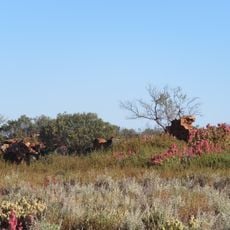
Walga Rock, Granite monolith in Shire of Cue, Australia
Walga Rock is a granite monolith about 48 km west of Cue, within the Austin Downs pastoral lease, and one of Australia's largest. A shallow cave in the rock holds an extensive gallery of Aboriginal art, including a painting of a two-masted steamship with a tall funnel.
Daisy Bates did not visit Walga Rock in 1908; her sketch Map 19, held at the State Library of Western Australia, marks "Walga" near Cue and Day Dawn. The first detailed examination of its art gallery was made in the 1930s by American anthropologist D. S. Davidson, who called it one of the most extensive galleries reported in Australia. The ship image was first described in the Geraldton Guardian in 1928.
The cave gallery at Walga Rock holds an extensive body of Aboriginal art, and the site is of profound cultural significance to the Wajarri people, whose elders are the acknowledged traditional owners. The American anthropologist D. S. Davidson examined the gallery in the 1930s and called it one of the most extensive galleries so far reported in Australia.
Walga Rock lies about 48 km west of Cue, inside the Austin Downs pastoral lease, reached by unsealed station tracks; check access with the leaseholder before setting out. The granite dome has no facilities or shade, so carry all water and fuel and allow for heat and flies. The art cave is reached on foot over uneven rock; visitors should not touch or wet the paintings.
The ship image, first described in the Geraldton Guardian in 1928, is now read as a two-masted steamship with a tall funnel, its "gunports" likely opening scuttles. Mid-west historian Stan Gratte, drawing on old Cue residents and the Ryan brothers, attributed it to Sammy "Malay", also known as Sammy Hassan, around 1917; four lines beneath may be Jawi script.
The community of curious travelers
AroundUs brings together thousands of curated places, local tips, and hidden gems, enriched daily by 93,363 contributors worldwide.