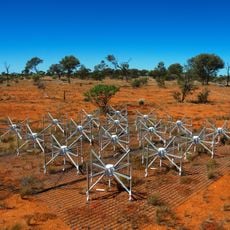
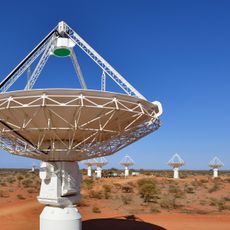
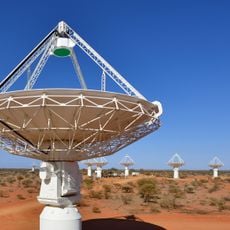
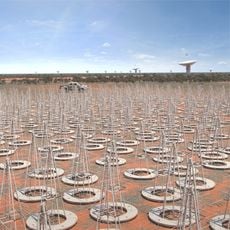
Experiment to Detect the Global EoR Signature, Radio telescope at Murchison Radio-astronomy Observatory, Western Australia
The Experiment to Detect the Global EoR Signature (EDGES) consists of two low-band instruments, each a dipole antenna about 2 by 1 metre on a 30 by 30 metre ground shield, separated by 150 metres and operating at 50–100 MHz. A high-band instrument of similar design covers 90–200 MHz. A 2023 version built the electronics into the antenna on a 50 by 50 metre ground plane.
Observations with the low-band instruments began in August 2015. In March 2018 the collaboration published a 78 MHz absorption profile in Nature, interpreted as a possible signature of primordial hydrogen; a 2022 SARAS experiment did not confirm it. A rebuilt low-band antenna with built-in electronics on a 50 by 50 metre ground plane started observing in June 2023.
EDGES is run jointly by Arizona State University and MIT's Haystack Observatory, with infrastructure from Australia's CSIRO. The name refers to the epoch of reionization, the period when ultraviolet light from the first stars ionised neutral hydrogen. The 2018 claim of a 78 MHz absorption feature drew wide attention, and in 2022 the Indian SARAS experiment reported it could not reproduce the result.
EDGES sits inside the Mid-West Radio Quiet Zone, a protected zone for radio equipment, so transmitters and electronic devices are restricted around the site. The two low-band instruments are separated by 150 metres, and a 100-metre cable links each antenna to its digital spectrometer. The site is not open to casual visitors; access is arranged through the Murchison Radio-astronomy Observatory.
In March 2018, the telescope detected an absorption pattern at 78 megahertz that revealed new clues about how the first stars formed. This discovery demonstrated that the instrument could actually capture signals from the very distant cosmic past.
The community of curious travelers
AroundUs brings together thousands of curated places, local tips, and hidden gems, enriched daily by 94,333 contributors worldwide.