Hutt Lagoon, Pink salt lake in Western Australia.
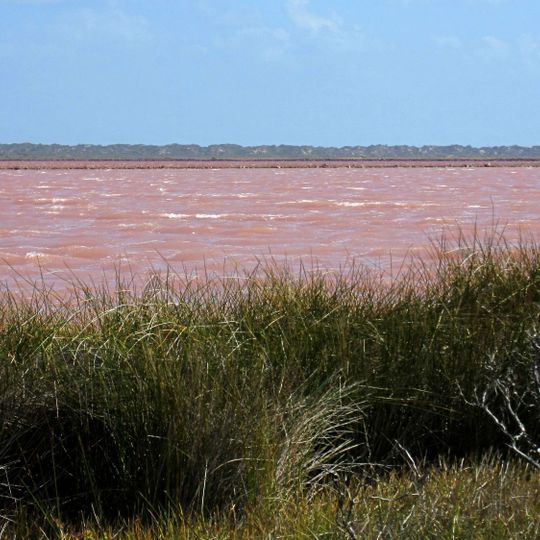
Hutt Lagoon is a salt lake on the Western Australian coast that stretches across several kilometers. The water shifts through various shades of pink and red depending on the angle of light and the time of year.
Hutt Lagoon was named by explorer George Grey, who camped on its eastern edge on 4 April 1839 during his second expedition along the Western Australian coast. He mistook the wet-season lagoon for a large estuary and named the supposed river and estuary after William Hutt, brother of Governor John Hutt. In January 1840 George Fletcher Moore aboard the schooner Champion found the Hutt River mouth dry and could not locate Grey's estuary. In 1854 Augustus Charles Gregory promoted the lagoon's salt and gypsum deposits, and from 1908 to 1924 the Port Gregory Saltworks shipped salt, producing about 4,000 tons a year with up to 50 workers.
The lagoon's name comes from William Hutt, brother of Western Australia's second governor John Hutt, chosen by explorer George Grey in 1839. Its salt was highly commended at the 1873 Sydney Intercolonial Exhibition, and gypsum from its western shore won a bronze medal there. Today the lagoon holds the world's largest microalgae production plant, 250 hectares of artificial ponds farming Dunaliella salina.
The lake sits along George Grey Drive between Geraldton and Kalbarri and is easily accessible by car. It is best visited in the morning when the water colors are most vivid.
The lagoon holds the world's largest microalgae production plant: 250 hectares of artificial ponds farming Dunaliella salina. Brine shrimp of the species Artemia parthenogenetica are also harvested commercially here as feed for prawn and fish farms and the aquarium trade.
The community of curious travelers
AroundUs brings together thousands of curated places, local tips, and hidden gems, enriched daily by 93,130 contributors worldwide.